








MARITIMEPOSTS.COM — Indonesia is an archipelagic nation with more than 17,000 islands and a blue horizon that for centuries has promised boundless abundance.
In reality, the myth of the infinite ocean is now beginning to collapse.
First, The Myth of the Infinite Ocean
Indonesia is an archipelagic country with more than 17,000 islands and a vast blue horizon that has long symbolized endless wealth. However, that myth is fading.
Beneath the surface, a silent crisis is reaching a critical point: we are no longer merely fishing—we are liquidating our own marine capital.
“On that basis, the Indonesian government has shifted toward a firm, technology-based framework through the Measured Fishing (Penangkapan Ikan Terukur/PIT) policy,” said the Director of Fish Resource Management at the Directorate General of Capture Fisheries, Ministry of Marine Affairs and Fisheries, Syahril Abdul Raup, to Pelakita.ID on Friday, March 27, 2026.
According to him, this is not just a policy update, but a fundamental shift from reactive exploitation to a proactive quota-based system aimed at preventing ecological collapse.
“In essence, it shows that fish resources are nearing collapse and must be managed through the PIT approach. A quota-based system must be adopted in Indonesian fisheries, as already implemented in bluefin tuna and lobster seed (BBL),” he explained.
Second, The 50 Percent Threshold: A Warning Signal for Indonesian Waters
From a foundational perspective, Syahril emphasized that there are strong and critical reasons behind this policy shift.
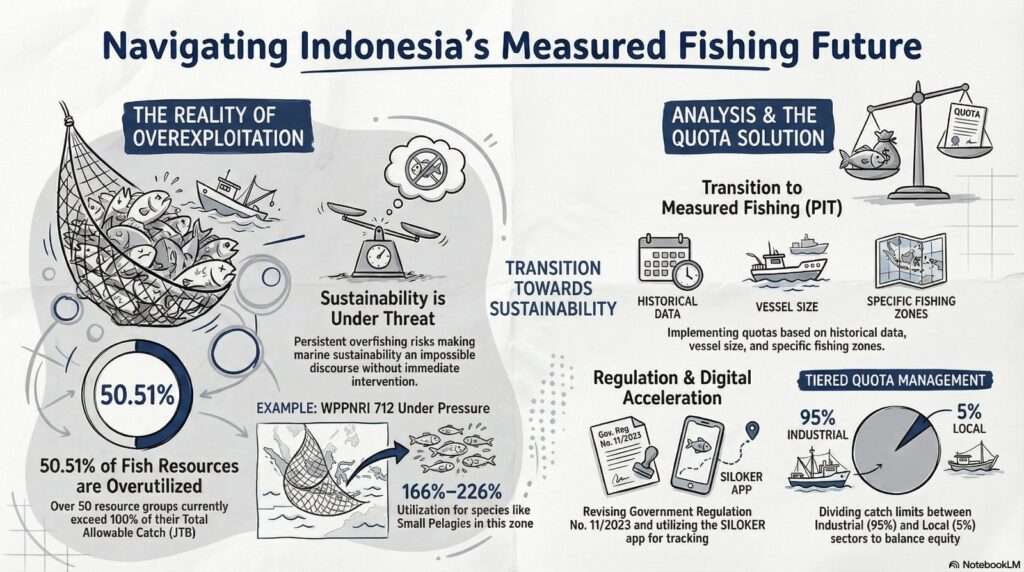
“Data from 2024 provides a serious warning for the future of Indonesia’s blue economy. Based on the latest evaluation of Indonesia’s Fisheries Management Areas (WPPNRI), out of 99 fish resource groups, 50.51% have been exploited beyond 100% of their Allowable Catch (JTB),” he revealed.
He stressed that JTB represents the safe limit needed to maintain biological balance.
“Exceeding this limit is not just overfishing, but a systematic depletion of resources that sustain millions of livelihoods,” he asserted.
He further highlighted data from WPPNRI 712 (Java Sea), where the situation is even more alarming. Small pelagic fish are exploited at 166% of JTB, while squid has reached 231%.
“Without intervention, sustainability will remain mere political rhetoric. Policy evaluations clearly state that implementing quota-based PIT is a rational solution that must be adopted immediately,” he added.
Third, The “Payback” Rule: Accountability at the 80 Percent Threshold
National Coordinator of Destructive Fishing Watch Indonesia, Mohammad Abdi, viewed the issue from a fisheries management perspective. He noted that similar practices have already been applied in tuna management.
“We observe that Indonesia has adopted strict management practices similar to those used for Southern Bluefin Tuna, introducing a ‘Payback’ mechanism that brings precise accounting into open-sea operations. This system can replace vague oversight with strict control of fishing efforts across other commodities,” he explained.
“When operators reach 80–100 percent of their quota, they must adjust their operations, including relocating from certain coordinates and increasing gear depth to reduce catch intensity,” he said.
If they exceed 100 percent, the excess catch is deducted from the following year’s quota.
Abdi emphasized that the system is not purely punitive.
“There is a Compliance Assessment mechanism that provides incentives for responsible operators, shifting the industry from ‘unlimited harvesting’ to ‘real-time traceability.’ However, its implementation requires strong coordination and synergy, especially with the fisheries industry,” he added.
Fourth, Digital Guardians: The SILOKER Revolution and the 3-Day Rule
Syahril also explained the management of high-value commodities such as lobster seed (BBL), which is now fully digitized through the SILOKER application.
“The government, through the Ministry of Marine Affairs and Fisheries, has established this platform as a digital guardian to ensure that every seed taken from the wild has a valid Certificate of Origin (SKA),” he stated.
In a major bureaucratic breakthrough, SILOKER applies an automatic approval system.
“If within three calendar days a provincial office does not process a quota request, the system will automatically approve it,” he explained.
This mechanism prevents administrative delays from disrupting digital governance. Additionally, fisherman groups (minimum of 10 members) must demonstrate at least 80% realization of their catch before applying for additional quota, to prevent misuse of permits.
Fifth, Redefining Small-Scale Fishermen: Precision in Effort Control
To ensure fairness in the quota system, Abdi stressed that the definition of “small-scale fishermen” must be measurable.
“We should appreciate that the government is moving from rigid regulation toward revising Ministerial Regulation No. 28/2023, introducing a 5 Gross Tonnage (GT) threshold as the main standard,” he said.
He noted that the government plans to remove the number of fishermen as a basis for quota allocation.
“This simplifies governance, as fishing capacity is already reflected in vessel size and gear type. It also prevents double counting between central and regional authorities, resulting in cleaner and more transparent records,” he explained.
Sixth, The Local Tuna Ledger: Strengthening Provincial Roles
Both Syahril and Abdi agreed that the PIT policy also promotes decentralization by distributing national quotas to provincial levels, particularly in WPPNRI 714 (Banda Sea).
“This ensures that local fishermen within the 12-nautical-mile zone are not displaced by industrial fleets,” said Syahril.
They noted that tuna quota distribution reflects detailed allocations.
Syahril explained that Maluku has a potential allocation of 7,884.63 tons of skipjack, 10,359.90 tons of yellowfin tuna, and 568.73 tons of bigeye tuna.
“Southeast Sulawesi: 7,002.56 tons of skipjack; 4,179.77 tons of yellowfin tuna; 294.48 tons of bigeye tuna. Central Sulawesi: 2,110.25 tons of skipjack; 271.16 tons of yellowfin tuna; 233.10 tons of bigeye tuna,” he detailed.
He emphasized that this approach provides local governments with both the data and authority to manage sustainable limits while staying connected to global markets.
A New Era of the Blue Economy
As an organization actively engaging with the government, Mohammad Abdi stated that the acceleration of this policy is underway, though implementation remains challenging.
He revealed that both institutionally and individually, DFW Indonesia has been involved in regulatory harmonization and public consultations throughout 2025.
Meanwhile, Syahril added that these processes will culminate in April 2026 with the launch of the book “Transformation of Indonesian Fisheries Governance: Theory and Practice of Measured Fishing.”
“We are now faced with a difficult reality: the era of unlimited exploitation is over. The ocean has limits, and without careful management, those limits will soon be exceeded,” he said.
The question remains: is a technology-based quota system the only way to save the ocean from ourselves?
For Syahril and Abdi, the answer is clear—data shows that without a radical shift toward accountability, the “infinite ocean” will become nothing more than a memory.
Editor: Denun