










MARITIMEPOSTS.COM – The enactment of Indonesia’s new Penal Code under Law No. 1 of 2023 marks a decisive shift in the country’s criminal law paradigm. At its core lies a principle too often neglected in practice: mens rea—the mental element of guilt as the true foundation of criminal responsibility.
This is not merely a technical adjustment; it is a corrective to a long-standing failure. For too long, law enforcement in Indonesia has been preoccupied with punishing outcomes while ignoring intention. The new KUHP challenges that tendency head-on.
The law reaffirms the classical doctrine of nullum crimen sine lege—no crime without prior law—but goes further by recognizing the “living law” within society as a legitimate consideration. This is a bold move. It signals that legality can no longer be confined to rigid textualism; it must evolve into a more dynamic, socially grounded understanding of justice. Law is not just what is written—it is what is lived.
More critically, Article 37 establishes a firm boundary: no one may be punished without proven fault.
This embodies the principle of nulla poena sine culpa—no punishment without guilt. In theory, this should act as a constitutional safeguard against arbitrary prosecution.
In practice, however, it demands something far more challenging: law enforcers must prove intent (dolus) or negligence (culpa) before imposing punishment. This is where the real battle lies—shifting from a formalistic to a substantive conception of justice.
The case of Baiq Nuril stands as a stark reminder of what happens when mens rea is ignored. Formally, she was convicted for distributing explicit material.
Substantively, she was defending herself against harassment. Under the framework of coercion and self-defense outlined in the new KUHP, her actions should have been interpreted differently. The presidential pardon she eventually received was not merely an act of mercy—it was an implicit admission that the legal system had failed to grasp the moral reality of the case.
A similar tension appears in the AQJ traffic accident. There was no intent to kill, yet there was undeniable negligence. The new KUHP rightly distinguishes between deliberate crime and fatal consequence arising from carelessness.
This distinction is not trivial—it determines the degree of culpability, the type of punishment, and ultimately the purpose of sentencing itself. Justice cannot be blind to nuance.
The criminalization of medical professionals, as seen in the case of Dr. Ayu, further exposes the dangers of a rigid legal approach. In high-risk professions, failure does not automatically equate to fault. The law must account for professional context and the limits of human capacity under pressure. Without such sensitivity, criminal law risks creating a climate of fear that undermines public interest rather than protecting it.
The real problem in Indonesia’s justice system is not the absence of rules—it is the dominance of a formalistic enforcement culture. Too often, legal actors focus narrowly on proving that an act occurred, while neglecting the far more difficult task of understanding why it occurred.
This imbalance fuels wrongful prosecutions and erodes public trust in the justice system. The new KUHP offers a critical opportunity to correct this—but only if its principles are taken seriously.
Legal reform cannot stop at legislation. It must penetrate institutions. Legal education must emphasize criminological and psychological analysis, not just doctrinal memorization.
Law enforcement officers must be equipped with the tools to assess intent, motive, and social context. Otherwise, the progressive provisions of the new KUHP will remain symbolic—impressive on paper, irrelevant in practice.
Ultimately, the strengthening of mens rea in the new KUHP reflects Indonesia’s aspiration to build a more civilized system of criminal justice.
The lessons from Baiq Nuril, AQJ, and Dr. Ayu are clear: justice is not only about what happened, but why and how it happened. The law must move beyond surface-level facts and confront the deeper moral dimensions of human action.
The real challenge now is ensuring that these principles do not remain trapped in statutory text. True reform is not just about changing the law—it is about transforming how justice itself is understood and delivered.
Author Information
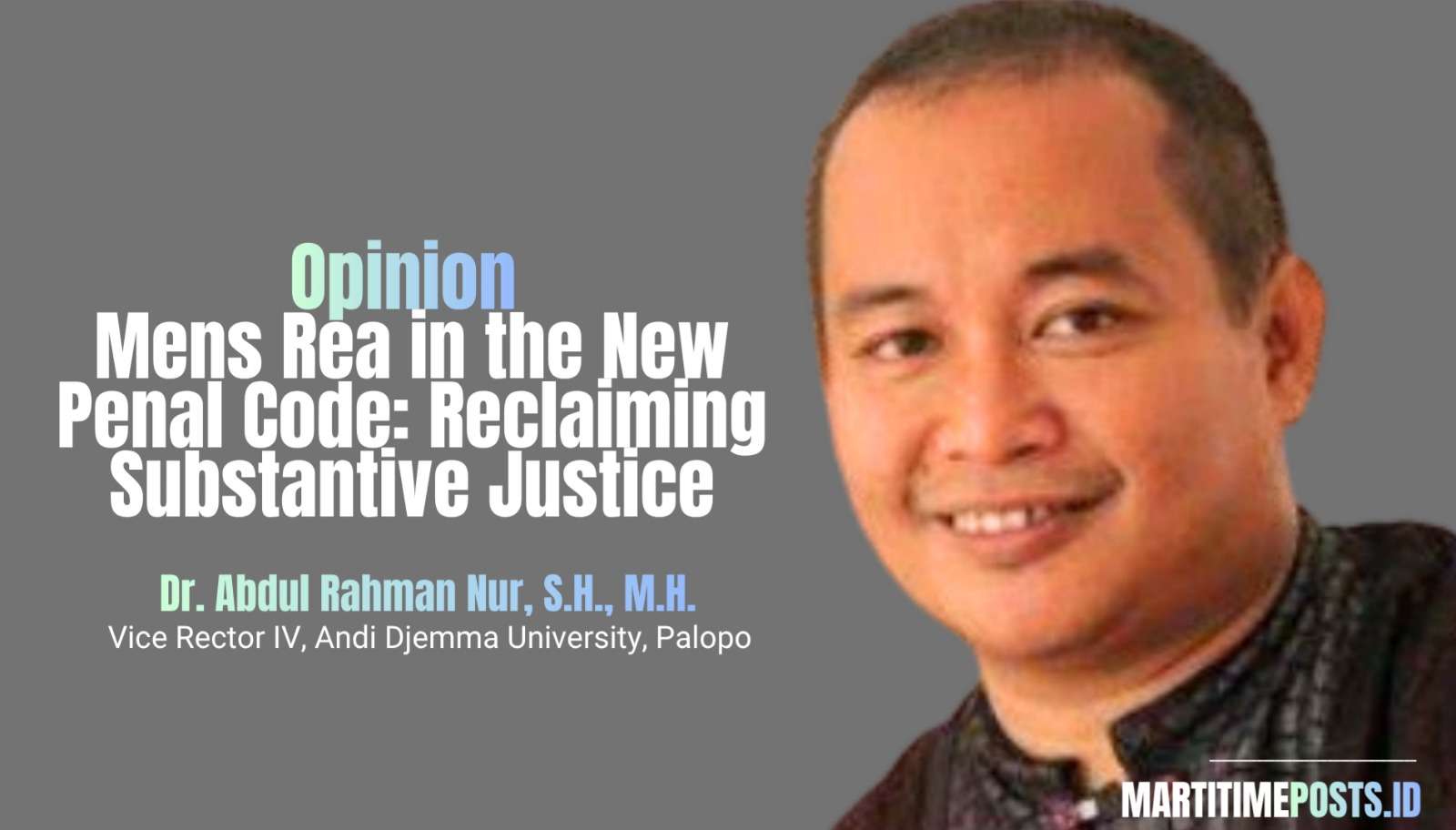
Name: Dr. Abdul Rahman Nur, S.H., M.H.
Position: Vice Rector IV, Andi Djemma University, Palopo
Address: Jl. Andi Djemma No. 123, Palopo City
Phone: +62 811-4221-328