








Interview with Dr. Supriadi Mashoreng, a Mangrove Expert at the Faculty of Marine and Fisheries, Hasanuddin University.
MARITIMEPOSTS.COM – Along the coastlines of Indonesia, from bustling fishing villages to the fragile ecosystems of the Spermonde Islands, scenes of environmental optimism are easy to find.
Volunteers gather in muddy tidal flats, carefully planting rows of mangrove seedlings, their smiles captured in photos that symbolize hope. Yet beneath this powerful imagery lies an inconvenient truth: despite the growing number of restoration initiatives, coastal ecosystems continue to decline.
Insights from Dr. Supriadi Mashoreng, a leading mangrove expert from Hasanuddin University, challenge the very foundation of how marine restoration is currently practiced. His message is clear and uncomfortable—most restoration efforts fail not because of a lack of effort, but because of a flawed approach.
The Illusion of Success
At first glance, planting thousands of mangroves appears to be progress. But in reality, many of these initiatives prioritize visibility over viability. Restoration has been reduced to ceremonial events—budget-driven, deadline-oriented, and often disconnected from ecological realities.
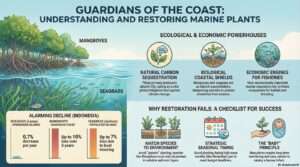
Meanwhile, scientific observations in Indonesia reveal a steady annual decline of seagrass ecosystems. This signals a deeper issue: we are measuring success by how much we plant, rather than how much actually survives.
Mangroves Are Not Projects—They Are Lives
Dr. Supriadi offers a powerful analogy: mangroves are not infrastructure projects; they are living organisms—more like infants than finished products.
A newly planted seedling is extremely vulnerable. It faces threats from grazing organisms such as gastropods, suffocation by plastic waste, and the relentless force of tides. Without proper support structures like stakes (“ajir”) and continuous care, mortality rates are alarmingly high.
His perspective reframes the entire restoration paradigm. Planting is only the beginning. Like raising a child, mangroves require years of nurturing, monitoring, and protection. Without this long-term commitment, restoration efforts collapse as soon as the spotlight fades.
The Overlooked Enemy: Everyday Habits
While public discourse often points to climate change or industrial pollution as the main drivers of marine degradation, Dr. Supriadi highlights a more immediate and underestimated threat: routine human behavior.
In island clusters such as the Spermonde region, the repeated dropping and dragging of boat anchors causes significant physical damage to seagrass beds. This daily activity, though seemingly minor, accumulates into large-scale destruction—outpacing the ecosystem’s natural ability to recover.
It is a sobering reminder that restoration cannot succeed if destructive habits continue unchecked. We cannot rebuild ecosystems while simultaneously dismantling them.
The Budget Trap: When Ecology Loses to Administration
Another critical failure lies in what Dr. Supriadi describes as “budget flushing”—the rush to spend allocated funds before fiscal deadlines expire. This administrative pressure leads to two recurring mistakes.
First, there is an overreliance on easily available mangrove species, particularly Rhizophora. While convenient, these species are often planted in unsuitable environments, ignoring the specific ecological conditions required for survival.
Second, planting frequently occurs at the wrong time of year. In many cases, projects are executed toward the end of the fiscal calendar—around November—when weather conditions are at their worst. Strong waves and storms during this period drastically reduce survival rates, turning restoration into an exercise in futility.
The Science of Success
For restoration to work, it must be grounded in ecological precision rather than administrative convenience. According to Dr. Supriadi, three pillars are essential:
- Species–Site Compatibility: Matching the right species to the right environmental conditions.
- Timing and Oceanographic Awareness: Planting during calm, favorable seasons—not dictated by budgets.
- Legal and Land Certainty: Ensuring restored areas are protected from future conversion or conflict.
Without these, even the most well-funded projects are destined to fail.
More Than Trees: The Foundation of Coastal Life
Mangroves and seagrass are not مجرد environmental accessories—they are the backbone of coastal ecosystems and economies.
They act as powerful carbon sinks, absorbing carbon dioxide and helping mitigate climate change. Physically, they serve as natural barriers, reducing wave energy and protecting shorelines from erosion.
More importantly, they are nurseries for marine life. Fish, shrimp, and countless other species depend on these habitats during their early life stages. When these ecosystems disappear, the impact ripples outward—affecting food security, livelihoods, and entire coastal economies.
Redefining Success
The central lesson from Dr. Supriadi’s insights is both simple and transformative: restoration must be measured not by the number of seedlings planted, but by the ecosystems that survive and thrive.
This requires a shift in mindset—from short-term projects to long-term stewardship, from symbolic actions to scientific rigor, and from visibility to accountability.
If we continue to prioritize ceremonies over sustainability, our efforts will remain superficial—washed away with the tides. But if we embrace the slower, more demanding path of ecological restoration, there is still hope to rebuild what has been lost.
The future of our coastlines depends not on how many trees we plant today, but on how many ecosystems we sustain for generations to come.