







The Hook: A World Without Water
MARITIMEPOSTS.COM – The ocean is the world’s greatest time capsule, a silent vault that has spent millennia guarding the remnants of lost empires behind a wall of impenetrable blue.
Until recently, the secrets of the seafloor—and the deep desert—were locked away by the sheer opacity of water and sand. But today, the paradigm is shifting.
Using advanced imaging technology like sonar, magnetometry, and Lidar, we are no longer just looking through these mediums; we are effectively “draining” them. By treating sand and water as data points that can be digitally removed, we reveal 3D landscapes that haven’t been seen for thousands of years.
These digital excavations are doing more than uncovering ruins; they are providing the forensic evidence needed to rewrite the human story.
The Pharos: A Straight-Walled Masterpiece
For centuries, the appearance of the Lighthouse of Alexandria—one of the Seven Wonders of the Ancient World—was a matter of artistic guesswork. Historical illustrations often depicted a tiered, sloping structure resembling a wedding cake. However, by digitally draining the Mediterranean at the entrance of Alexandria Harbor, archaeologist Isabelle Hairy has uncovered the architectural truth.
The survey identified nearly 3,000 granite blocks scattered across the seabed. Analysis of these blocks revealed a stunning technical detail: there is no evidence of sloping in the masonry.
The walls of the Pharos were perfectly straight. Standing approximately 330 feet tall—equivalent to a modern 32-story building—the lighthouse was a skyscraper of the ancient world. It was crowned with a revolutionary beacon system utilizing fires and iron mirrors to reflect light up to 30 miles out to sea.
The sheer scale of the engineering is exemplified by the remains of the main entrance: a 41-foot doorframe that once supported a massive 200-ton wooden door.
“Alexandria’s lighthouse is a technological and architectural masterpiece. Built in the third century BC, it’s the crowning glory of a new capital city.”
The Abydos “Sports Cars” of the Afterlife
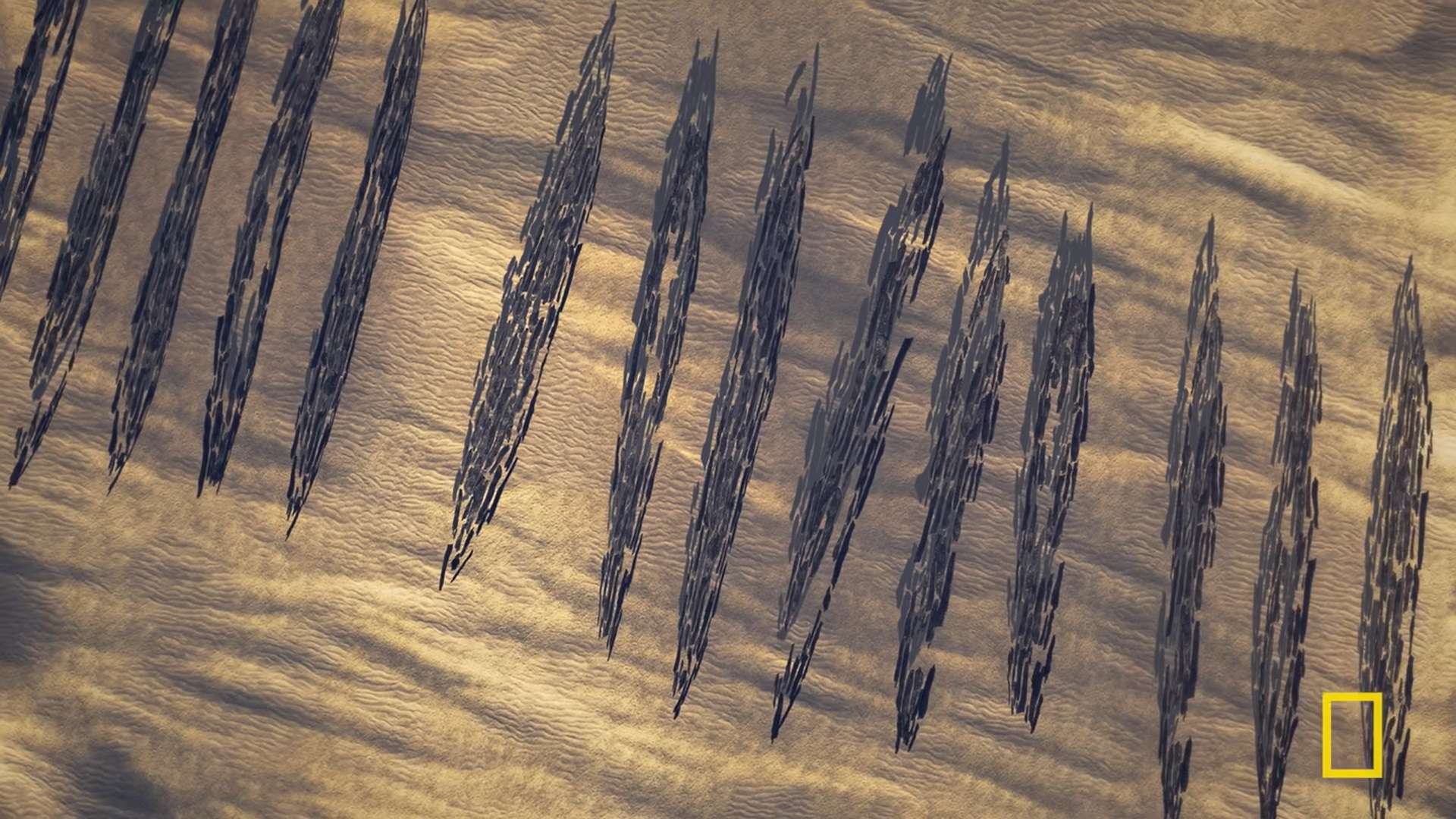
Six miles into the desert plateau, far beyond the reach of the Nile’s shifting course, lies a “phantom flotilla” that predates the Great Pyramids by 200 years. To find this site, researchers utilized magnetometry—a survey method that detects variations in the soil’s magnetic field—to peer beneath the dunes.
What they found was the original “Valley of the Kings.”
Buried here are 14 vessels, each 60 feet long. These are not simple reed rafts; they are the earliest plank-built boats ever discovered in the region, featuring advanced construction where wooden timbers were stitched together with rope.
At 5,000 years old, they represent the “sports cars” of the Early Dynastic period—a massive state investment in nautical technology for the Pharaoh’s use on the “celestial Nile” in the afterlife.
- The Boat Graves: To ensure these vessels survived for eternity, each was encased in a white-plastered mud-brick structure. When first built, these 14 graves would have caught the sun, glowing brilliantly against the desert sand as a permanent monument to the King’s power and his transition to the next world.
The “Breathing” Sin City of Baiae
The Roman resort of Baiae was the “Las Vegas” of antiquity, a playground of vice where the elite indulged in thermal springs and lavish banquets. Today, 430 acres of this city lie submerged, but its disappearance wasn’t caused by a sudden flood. Instead, Baiae was a victim of bradyseism—the gradual uplift or descent of the Earth’s surface caused by the filling and emptying of underground magma chambers.
The city sits within the Campi Flegrei (the “Fields of Fire”), a massive volcanic crater. These subterranean chambers act like geological bellows; as they empty, the ground sags, pulling the city downward.
Draining the Bay of Naples reveals the staggering luxury left behind, such as the Nymphaeum of Emperor Claudius, an elaborate dining room where marble nymphs still stand.
Seneca the Younger once described the city as a “harbor of vice” where people wandered drunk along the beach and the lakes were noisy with the sounds of singing.
Vikings: The First Hydrodynamic Engineers
While popular legend casts them as mere raiders, the Vikings were, in fact, master hydrodynamic engineers. Draining the waters of southern Norway and surveying burial mounds has allowed us to decode the “DNA” of their success.
The secret was “clinker-built” construction: overlapping oak planks fastened with iron rivets. This design provided a flexible hull that didn’t fight the ocean but rather “swallowed the waves,” riding atop the water with a streamlined profile centuries ahead of its time.
As their society evolved from raiding to global trade, so did their naval architecture. Digital excavations of sites like the “grindstone wreck” reveal ships that were wider and deeper than traditional longships.
These were dedicated cargo vessels capable of hauling 75-pound schist grindstones and reindeer antlers. This engineering shift enabled a trade network that stretched from North America to the Black Sea, connecting the Vikings to the farthest reaches of Asia.
Herculaneum’s Exploding Skulls: A Grimmer End
The eruption of Mount Vesuvius in AD 79 provides a stark forensic contrast between two neighboring cities. While both were destroyed, the way the victims died reveals the differing physics of volcanic destruction. By draining the volcanic ash and debris from the boat chambers at Herculaneum’s ancient beachfront, scientists discovered hundreds of skeletons that tell a much more violent story than those in Pompeii.
Forensic analysis of the Herculaneum remains found a “reddish-brown mineral residual” inside the skulls, indicating that the victims’ brains boiled and their skulls exploded instantly. They were hit by a pyroclastic surge reaching temperatures of 500°C, causing instant thermal shock.
- Pompeii (Suffocation/Ash): Victims died primarily from suffocation over 18–20 hours. Skeletons often display a “pugilistic attitude”—a pose where limbs are contracted due to the heat affecting the tendons after death.
- Herculaneum (Instant Thermal Vaporization): Victims died in a fraction of a second. The heat was so intense that soft tissue was vaporized instantly, leaving no time for the body to react or contract.
Rome’s Secret Weapon: The Pozzolana Fingerprint
At Caesarea Maritima, Roman engineers performed an “engineering miracle” by building the world’s first artificial harbor on a coastline with no natural inlets and shifting sands. To create “manmade bedrock,” they utilized a revolutionary material: hydraulic concrete.
By mixing lime with pozzolana—a specific volcanic ash found on the slopes of Mount Vesuvius—they created a concrete that hardened upon contact with seawater. The logistics were staggering: the Romans barged tons of this ash 1,000 miles across the Mediterranean to the Judean coast.
To pour the foundations, they used caissons, wooden frameworks dropped into the sea to hold the liquid concrete in place until it solidified. This enabled them to build a 40-acre port facility where nature had provided no foundation.
The Survivors’ Legacy
The “drained” ruins of the past prove that ancient civilizations were the ultimate survivors. When environmental or political crises struck, they adapted.
This is most evident in the lost Maya kingdom of Sak Tz’i (translated as “White Dog”). By using Lidar to “peel back” the dense jungle canopy of Lacanjá Tzeltal, archaeologists discovered that the Maya didn’t simply “collapse” in the 9th century.
Instead, faced with drought and a catastrophic loss of trust in their government, the people “voted with their feet.” They abandoned the capital, moved to the Yucatán, and adopted more resilient farming techniques.
These sites serve as a testament to human resilience. As we look at the ruins of Baiae or Caesarea, we have to wonder: in another 2,000 years, what story will our own coastal cities tell when future archaeologists finally “drain” the oceans of our era?
Source