

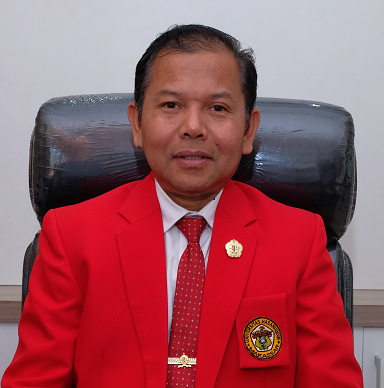
He is recognized as the first researcher in Indonesia to actively promote the implementation of the Healthy City concept in multiple regions, playing a key role in guiding districts and cities toward healthy accreditation through the Swasti Saba Padapa indicators and national verification.
maritimeposts.com/ – Prof. Sukri Palutturi, SKM, M.Kes., MSc.PH, Ph.D., was born in Tanatoa, South Sulawesi, on May 29, 1972, and is one of the leading figures in the development of public health policy in Indonesia.
He currently serves as the Dean of the Faculty of Public Health (FKM) at Hasanuddin University (Unhas), an “A”-accredited institution that serves as a center for public health education and research in eastern Indonesia.
Prof. Sukri Palutturi’s strong academic background and extensive professional experience make him one of Indonesia’s foremost experts in health policy and politics, the implementation of Healthy Settings, and the development of Healthy Cities in Indonesia and Southeast Asia.
Education and Academic Development
Prof. Sukri Palutturi pursued a systematic and comprehensive educational path. He completed his undergraduate degree (S1, SKM) and master’s degree (M.Kes.) in Health Administration and Policy at FKM Unhas in 1998 and 2002, respectively.
He expanded his international perspective by earning a Master of Science in Public Health (MSc.PH) and a Ph.D. at the Center for Environment and Population Health, Griffith University, Australia, in 2009 and 2013.
Additionally, Prof. Sukri attended the Regular Education Program (PPRA) LXIII at the National Resilience Institute (Lemhannas) of the Republic of Indonesia in 2022, further strengthening his strategic leadership capacity in public health and policy.
Academic and Professional Career
Prof. Sukri Palutturi has followed a consistent career trajectory, beginning as a civil servant (CPNS) in 2001 and advancing to Pembina Utama Madya (IV/d) in 2020. He achieved the rank of Professor in 2017, becoming one of the five youngest professors at Unhas that year.
He began his academic career as a permanent lecturer in the Department of Health Administration and Policy, FKM Unhas, in 2001 and has held several strategic positions, including Department Secretary (2006–2008), Vice Dean for Student Affairs, Alumni, and Partnerships (2014–2022), and currently serves as Dean for the 2022–2026 term.
Prof. Sukri’s expertise covers health policy and politics, development of Healthy Settings, and the implementation of the Healthy Cities concept—his flagship area in Indonesia.
He is widely recognized as the first researcher in Indonesia to implement the Healthy City concept, actively supporting districts and cities in achieving healthy accreditation through the Swasti Saba Padapa indicators and national verification.
The Healthy Cities concept developed by Prof. Sukri goes beyond physical health, encompassing social welfare, environmental sustainability, and community participation in creating environments that support public health.
Research and Publications
As a productive academic, Prof. Sukri has an H-index of 12 on Scopus with over 2,100 citations and an H-index of 25 on Google Scholar.
Over the past five years, his research has addressed topics such as community motivation to pay national health insurance contributions, midwife skill enhancement, stunting management, primary healthcare quality, environmental health, and the application of Bugis local philosophy in hospital services.
These studies are not only theoretical but also practice-based and relevant for health policy development in Indonesia.
Books
In addition to scientific publications, Prof. Sukri has authored several books that are important references in public health and health policy in Indonesia, including:
-
Kesehatan itu Politik (2010)
-
Public Health Leadership (2014)
-
Health Politics: Theory and Practice (2015)
-
Healthy Cities: Global Concept, Local Implementation for Indonesia (2017)
-
Health Politics in Indonesia (2019)
-
Indonesia’s War Against COVID-19 (2022)
-
Developing Healthy Traditional Markets (2022)
These books demonstrate his commitment to bridging theory and practice while guiding evidence-based health policy development.
International Training and Conferences
Prof. Sukri actively participates in professional training and international conferences, expanding his global network and perspective. Selected international programs include:
-
Short Course on Health Policy Development (Australia, 2010)
-
Healthy Cities (Adelaide, 2012)
-
Universal National Health Insurance (Mahidol University, Thailand, 2014)
-
Urban Governance for Health and Wellbeing (Geneva, 2023)
-
Mayor’s Meeting: Strengthening Healthy Settings under Age-Friendly Cities (Malaysia, 2025)
These experiences strengthen his contributions to urban health strategy, public health policy, and evidence-based community health development.
Contributions to Public Health Policy
Prof. Sukri has played a significant role in public health policy in Indonesia, acting as a facilitator and resource person in areas including:
-
Developing Healthy City indicators
-
Training healthcare workers and midwives
-
Assisting the development of healthy corridors
-
National seminars on health politics and GERMAS implementation
He has actively supported national health insurance policies (JKN), improved primary healthcare quality, and empowered communities for preventive and promotive health. His work spans city, district, and provincial levels, collaborating with government agencies, international organizations, and academics at global conferences.
International Impact
Globally, Prof. Sukri has contributed to urban health development through workshops and seminars across Asia and Europe, including Malaysia, Thailand, Nepal, Tunisia, Switzerland, and Bangkok. He focuses on strengthening city government capacity, developing city health profiles, and implementing Healthy Cities in developing countries, emphasizing cross-sector collaboration, community participation, and data-driven policymaking.
Conclusion
Overall, Prof. Sukri Palutturi is a distinguished academic and public health practitioner in Indonesia. With over two decades of experience in higher education, research, and policy development, he has built a strong record in advancing public health, developing Healthy Cities, and strengthening healthcare workforce and community capacity.
His contributions not only improve the quality of life in Indonesia but also serve as an important reference for public health practice regionally and globally. Prof. Sukri continues to inspire future generations of academics and health practitioners to formulate innovative, evidence-based, and contextually relevant policies with broad societal impact.