

With fluctuating shrimp prices driven by market dynamics, tax policy changes, and export regulations, securing price certainty through pre-harvest contracts is crucial for protecting farmers’ income and ensuring long-term sustainability in the Vannamei shrimp industry.
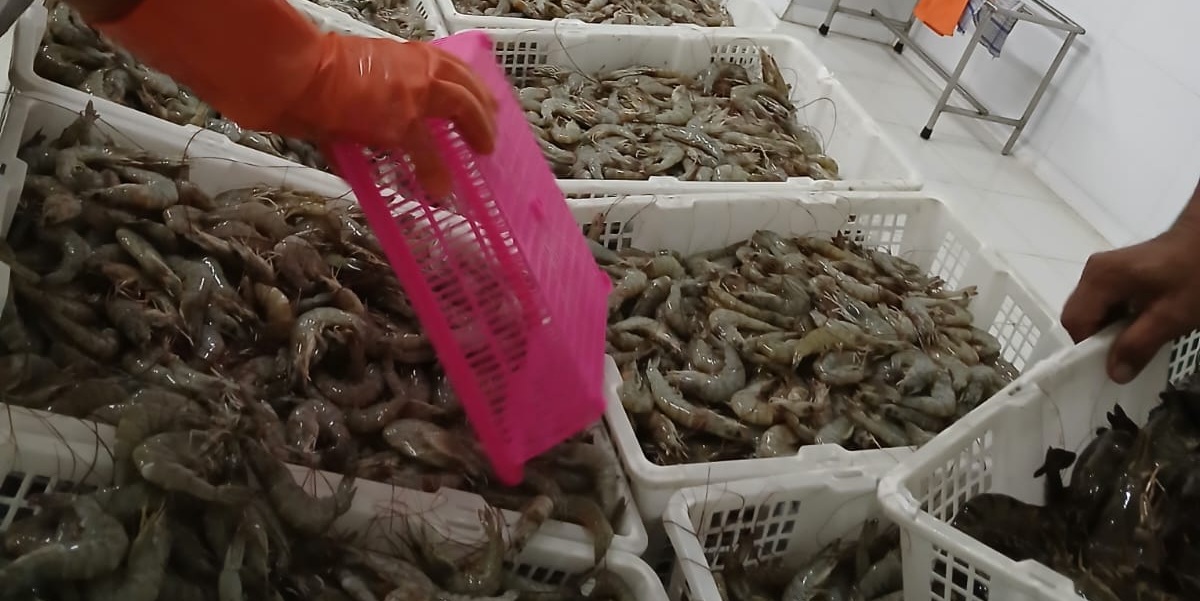
maritimeposts.com/ – This week, around 2,000 kilograms of Vannamei shrimp were recently sold at the Makassar Industrial Complex (KIMA) processing center, with prices reaching IDR 48,000 per kilogram.
“While local market prices generally offer better profit margins for farmers, the volume they can absorb remains limited,” Atjo Alamsyah, shrimp trader explained.
In contrast, shrimp destined for export or processing industries—particularly those heading to China and Taiwan—often receive lower prices due to international market standards and stricter pricing benchmarks set by buyers in those countries.
This imbalance explains why shrimp sizes between 80 and 100 per kilogram have become more common in circulation. Farmers managing large-scale operations, with harvests reaching up to 200 tons, cannot rely solely on local markets to distribute their stock efficiently.
Instead, they turn to export channels, even if the price per kilogram is slightly lower, to ensure volume absorption and cash flow continuity.
Price fluctuations have become a regular concern in this context. According to Atjo, a practitioner familiar with the shrimp trade, prices can rise or fall by IDR 1,000 to 2,000 in just a week.
He emphasized the importance of making agreements with buyers—particularly processing companies—before the harvest.
“We don’t want prices looking good before harvest and then suddenly dropping when we’re ready to sell. A pre-harvest contract ensures price certainty and protects farmers,” he said.
As of July 12, 2025, Vannamei shrimp prices have once again shifted, with larger-sized shrimp (which are fewer in number per kilogram) commanding the highest rates.
Shrimp in size 20 range fetched IDR 84,000 per kilogram, while smaller shrimp such as size 130 were priced at around IDR 40,000. This price structure reflects the industry standard: the fewer shrimp per kilogram, the higher the value due to more meat per unit.
Comparing this with the price data from June 15, 2025, the market has shown modest adjustments. Mid-sized shrimp such as those in the 30–70 size range saw minor decreases, between IDR 1,000 and 3,000.
In contrast, smaller shrimp (sizes 90 to 110) experienced slight increases, possibly due to increased demand or reduced supply. Other sizes remained relatively stable, suggesting a balancing effect influenced by seasonal cycles and market negotiations.
A more striking shift is visible when comparing the current prices to those from December 23, 2024—prior to a notable tax increase affecting the industry.
At that time, size 20 shrimp sold for just IDR 61,000 per kilogram. Today, the same size commands IDR 84,000—a surge of IDR 23,000. Even the smallest shrimp, size 130, increased from IDR 31,000 to 40,000, marking a nearly 29% rise.
This pattern indicates the shrimp market’s post-tax adaptation, compounded by rising production costs and stronger global demand.
For small-scale shrimp farmers, these trends highlight the urgent need for pre-harvest pricing agreements.
In a market affected by both regulatory shifts and unpredictable fluctuations, such contracts offer income stability, bargaining power, and protection from sudden downturns. Without them, even a successful harvest can feel like a gamble.
Written by K. Azis