
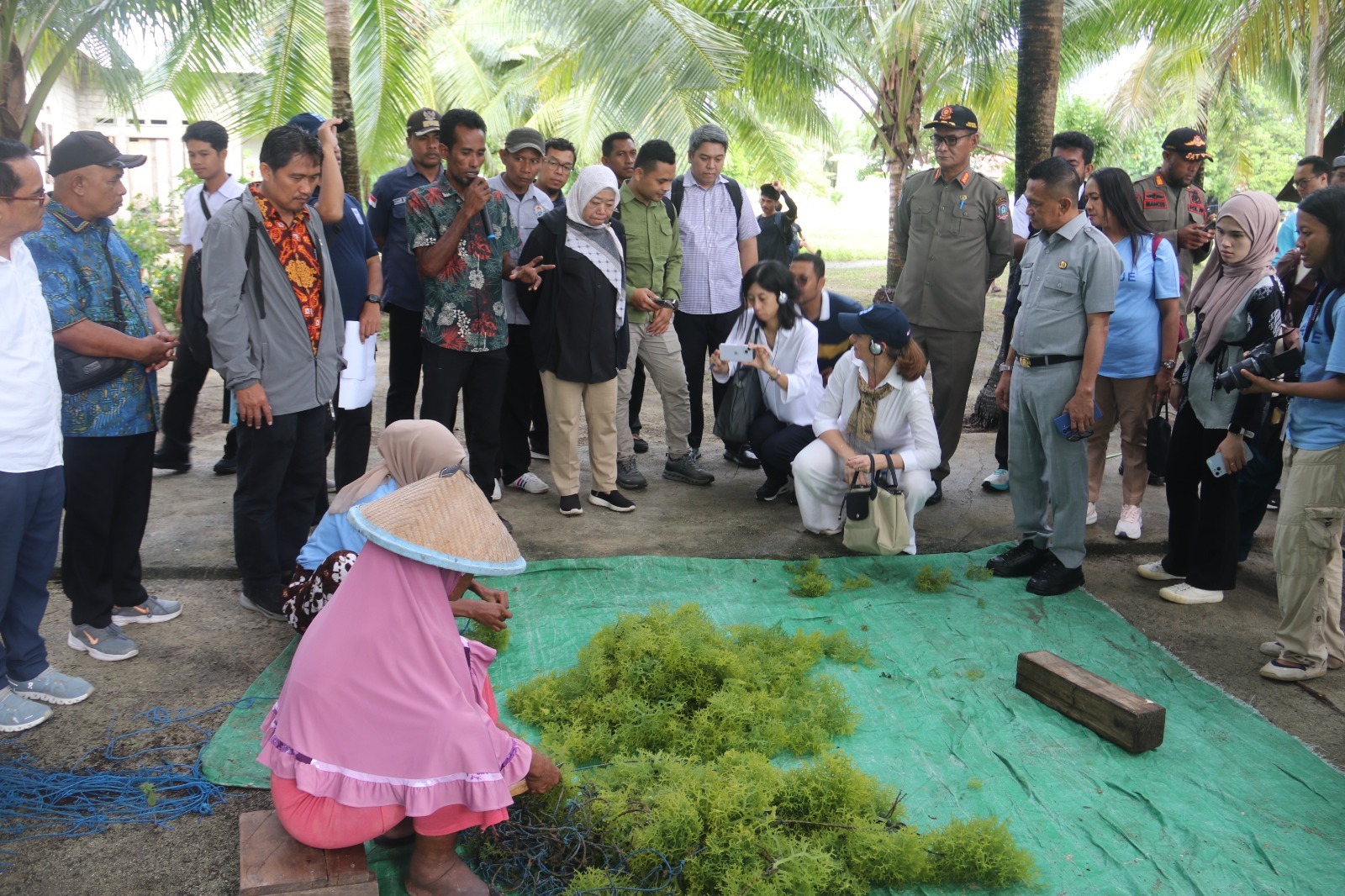
MARITIMEPOSTS.COM – The Ministry of Marine Affairs and Fisheries (KKP) continues to strengthen the implementation of the seaBLUE Project (Strengthening Livelihood of Small-Scale Fishers and Promoting Sustainable Local Economic Development through the Blue Economy) in Morotai Regency, North Maluku Province.
This collaborative project between KKP and the United Nations Development Programme (UNDP), supported by the Government of Japan, is part of a joint effort to improve the welfare of coastal communities while preserving the sustainability of Indonesia’s marine ecosystems.
The Head of the Marine and Fisheries Extension Center (Pusluh KP), Yayan Hikmayani, stated that the synergy within the seaBLUE Project has produced three main outputs.
The first output includes the registration of Business and Supporting Actors Cards (KUSUKA) for 1,126 stakeholders. In addition, training programs have been provided to 300 participants, including Fisher Competency Certification (SKN) and Fish Handling Skills Certification (SKPI) for 240 fishers, as well as product diversification training for 60 participants.
The second output involves the implementation of environmentally friendly technologies, including solar-powered freezers or cooling boxes at 19 points across 17 villages, a solar-powered electric boat engine in Galo-Galo Island, and training for technicians and operators to support the use of these technologies.
The third output focuses on strengthening business governance through vessel registration for Business Identification Numbers (NIB) for 230 vessels, installation of Automatic Identification Systems (AIS) for fishers who already hold NIB, and training for 60 regional civil servants.
“Marine and fisheries extension officers in Morotai will continue to assist in implementing this project while ensuring that KKP’s priority programs in the region deliver sustainable benefits,” Yayan stated in an official release in Jakarta on Friday (13/3).
In addition to the seaBLUE Project, KKP has also prioritized Morotai through the development of marine and fisheries infrastructure and human resources, such as the Integrated Marine and Fisheries Center (SKPT), Red-and-White Fishermen Village (KNMP), and Red-and-White Village Cooperative (KDMP), in line with the directive of Minister Sakti Wahyu Trenggono to ensure intensive assistance from extension officers.
The local KDMP chairman expressed appreciation for KKP’s support and proposed the development of a tuna processing facility to produce tuna loins by utilizing existing cold storage facilities. This would enable the community not only to sell whole tuna but also to process it into value-added products with export potential.
On Galo-Galo Island, seaBLUE National Project Coordinator Rifki Furqan praised the performance of extension officers, noting that they had exceeded project targets. For example, the target of registering 1,000 KUSUKA cards across multiple locations was achieved from a single activity site.
From an economic and social perspective, analysis by the Marine and Fisheries Socio-Economic Research Center (BBRSEKP) indicates that the project has a Social Return on Investment (SROI) with a total investment of IDR 243 million and an estimated total benefit of IDR 759 million over five years. This results in a net benefit of IDR 515 million, a break-even point within two years, and an SROI ratio of 3.1—meaning that every IDR 1 invested generates IDR 3.1 in social and economic benefits.
Yayan also highlighted positive outcomes in the field, including success stories from training participants. One example is Yenni, a housewife who participated in fish processing training and is now able to produce and market processed tuna products beyond Morotai. Previously, her husband, a fisherman, often gave away unsold tuna for free. Now, surplus catch can be processed into value-added products.
Products currently being developed include tuna nuggets, which can last up to two months in freezer storage without preservatives. In the future, communities plan to develop other derivative products such as fish sausages, fish balls, and fish sauce.
In addition to product diversification, the project has reduced fishermen’s operational costs. Yenni explained that her husband previously spent up to IDR 100,000 per day on ice blocks for handling catch. Now, the community can produce their own ice and even sell it for additional income.
According to Yayan, graduates of the processing training also have strong potential to become suppliers of nutritious food for the Nutrition Fulfillment Service Unit (SPPG) on Galo-Galo Island, which provides fish-based meals for school children, pregnant women, breastfeeding mothers, and the elderly.
The Regional Secretary of Morotai Regency, M. Umar Ali, welcomed the initiative, noting that other protein sources such as meat, eggs, and chicken are relatively expensive in the area, making fish the primary source of protein.
The field visit also included inspections of various facilities and community activities, including Green Technology Shelters equipped with charging stations and cooling boxes, SPPG facilities, seaweed farming, and organic soap production from mangroves.
“With the introduction of solar-based technologies, production costs can be reduced and community income can increase significantly. With these achievements, the implementation of the seaBLUE Project in Morotai is expected to strengthen the blue economy and improve the welfare of coastal communities. The role of extension officers is crucial in guiding communities toward sustainable use of marine and fisheries resources,” Yayan stated.
Previously, Minister Sakti Wahyu Trenggono called on marine and fisheries extension officers across Indonesia to serve as role models in implementing blue economy-based priority programs.
Public Relations
Marine and Fisheries Human Resources Development Agency (BPPSDM KP)
Source:
Public Relations, BPPSDM KP