

During extreme seasons, fuel and staple food distribution is disrupted, while infrastructure such as piers is damaged by waves and flooding. Data indicate that high waves and sea storms are the most feared threats among residents, followed by drought, strong winds, and weather uncertainty.
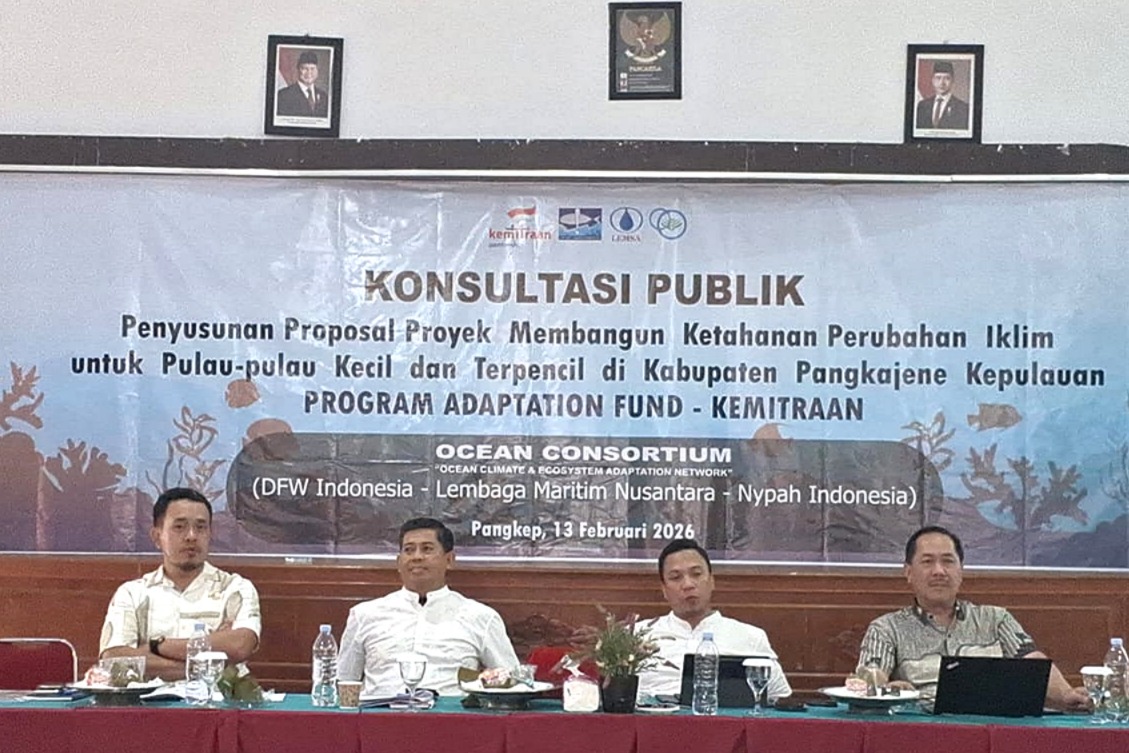
maritimeposts.com/ – Representative of the ‘Konsorsium OCEAN’, Urban El Fatih, presented the stages, field findings, and overarching framework of a climate resilience development project proposal for small island communities during a public consultation forum held at Mattampa Inn, Pangkep, on February 13, 2026.
He explained that from the outset, the project planning process had been conducted in a gradual, adaptive manner and remained open to input from various stakeholders, drawing from both internal learning and strategic partnerships.
According to Urban, throughout 2025 the project concept underwent multiple revisions before finally being approved to proceed to the project formulation grant stage in mid-year.
This stage opened opportunities for direct field data collection in Tanggaya and Kalmas Sub-districts.
In 2026, the OCEAN Consortium—comprising Destructive Fishing Watch Indonesia, Lemsa, and Nypah—conducted a public consultation as part of the data and information-gathering process before entering the final proposal drafting and official submission phase.
Given that the project duration is limited to a maximum of three years, implementation is projected to take place between 2027 and 2030 at the earliest.
Urban stated that field observations were carried out from November to December 2025 across ten villages, surveying approximately 150–155 households.
In addition to household surveys, the team conducted in-depth interviews with village heads, village government officials, and community leaders, along with focus group discussions (FGDs) in each village. Coastal ecosystem assessments were also undertaken, covering coral reefs, seagrass beds, and mangroves.
“Based on these findings, two sub-districts were selected as program loci, with four villages each in Tanggaya and Kalmas, considering cost efficiency and operational feasibility,” Urban explained.
The selection of these areas, he added, was grounded in the principle of climate justice. Small island communities contribute minimally to global emissions, yet they bear some of the most severe impacts of climate change.
In addition to being outermost and remote areas with extremely limited access—travel to Kalmas takes 12–15 hours, and to Tanggaya can reach 20–25 hours depending on weather conditions—these regions also include conservation areas vulnerable to ecological pressure.
Regarding climate change impacts, Urban highlighted a rising trend in air temperature and sea surface temperature of approximately 0.9 degrees Celsius, based on scientific projections and international data.
“Sea level rise from 1990 to 2021 has reached 80–92 millimeters, directly contributing to coastal erosion, groundwater contamination, and increasing tidal flooding. Community reports also show ongoing abrasion affecting settlements, assets, and land, along with seawater intrusion causing wells to become brackish,” Urban said.
Socio-economic impacts are increasingly evident, particularly in fisheries and seaweed cultivation. Small-scale fishers operating boats under 5 GT face heightened vulnerability during storms and often cannot go to sea for weeks at a time.
During extreme seasons, fuel and staple food distribution is disrupted, while infrastructure such as piers is damaged by waves and flooding. Data indicate that high waves and sea storms are the most feared threats among residents, followed by drought, strong winds, and weather uncertainty.
Between 2016 and 2025, eight boat sinking incidents with fatalities were recorded, along with 19 coastal storm events in the past three years.
The socio-economic profile of fishing households reveals high vulnerability. Around 60 percent of household heads have only elementary school education, with average incomes below the provincial minimum wage. Approximately 82 percent reported significant impacts from extreme weather, and 77 percent experienced drastic income declines.
Access to basic services such as health and education remains highly limited, while adaptive capacity is considered low, placing overall risk levels in the moderate-to-high category.
From a social and environmental health perspective, clean water scarcity is a serious issue. Seawater intrusion has made wells brackish, and sandy soil conditions limit rainwater retention.
“About 87–91 percent of households lack proper sanitation facilities, and healthcare access is difficult. Women bear a double burden, particularly in securing household water. In seaweed farming, ice-ice disease and weather unpredictability reduce product quality and market prices,” Urban added.
He also highlighted structural development challenges faced by small islands, including inadequate infrastructure, limited local data and information, and low budget allocation priority due to small populations and high development costs.
The lack of synchronization between national and regional adaptation policies, as well as limited human resource capacity, further constrains the effectiveness of adaptation efforts.
Based on these findings, the OCEAN Consortium formulated a project vision of “toward sustainable resilience” built upon four main pillars: participatory governance, adaptive livelihoods, ecosystem rehabilitation, and technological innovation.
This vision is translated into a theory of change aimed at realizing resilient and prosperous small island communities.
Targets include strengthening the adaptive capacity of village and district governments, enhancing community capacity and livelihoods, reinforcing coastal ecosystem resilience, and managing knowledge and dissemination of lessons learned.
Proposed activities include drafting small island adaptation plans at the district level, integrating village action plans into development planning documents, climate field schools, strengthening sustainable livelihoods, developing disaster SOPs, and installing local weather stations.
On the ecosystem side, mangrove and coral reef rehabilitation, along with community-based monitoring systems, are key components of the intervention.
In closing, Urban emphasized that the project is designed not merely as a short-term intervention but as a learning model that can be replicated in other small island regions across Indonesia.
Lessons learned will be disseminated through data systems, documentary films, photography, learning publications, and various media channels to ensure that the project’s impact extends beyond the immediate intervention sites.
Editorial Team