

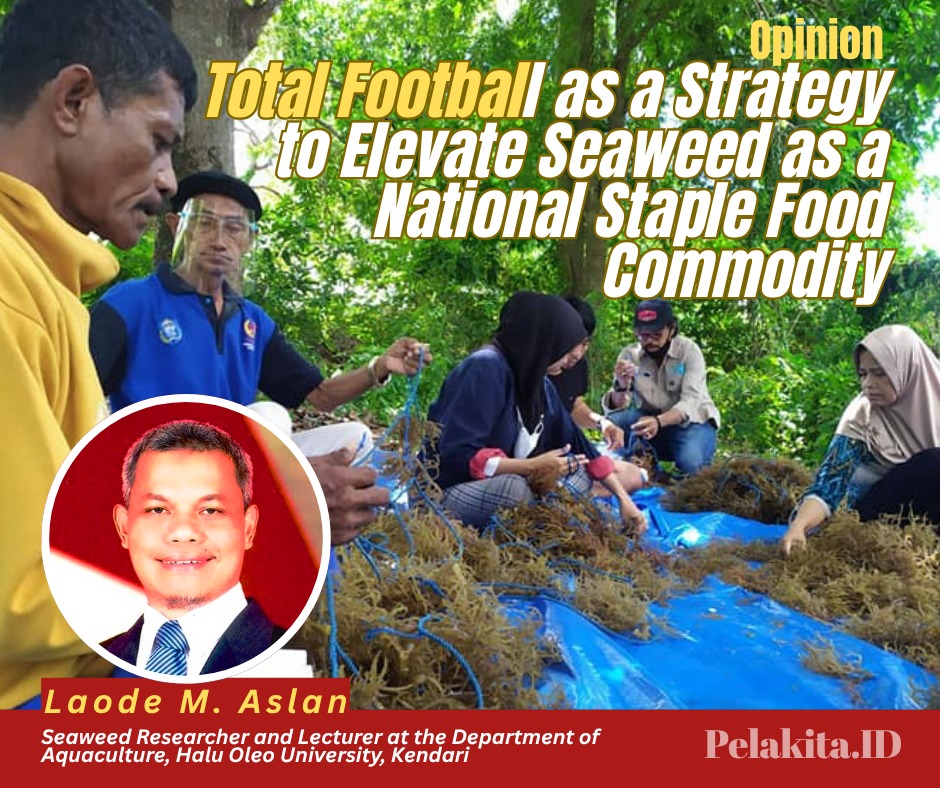
By: Laode M. Aslan (Seaweed Researcher and Lecturer, Department of Aquaculture, Halu Oleo University)
maritimeposts.com/ – When the Netherlands introduced the Total Football (TF) strategy in the 1970s and 1980s, it captivated the global football community. Under this system, every player could assume any position, operating with collective intent, flexibility, and mutual support to achieve a singular objective: team victory.
On the evening of July 29, 2025, Indonesia’s U-23 national team was defeated by Vietnam’s U-23 team in the AFF Cup, despite applying the TF approach under the guidance of a Dutch coach. However, this loss remains understandable, as the Indonesian squad is still in a transitional phase—adapting to the TF philosophy.
The players have yet to master the timing of pressing, positional rotation, and maintaining strategic cohesion in line with TF principles.
What relevance does this football strategy hold for national food policy? Why should the Total Football approach be considered when promoting a commodity to become a cornerstone of national food security?
The answer lies in the core attributes of Total Football: intersectoral collaboration, role adaptability, and agile responsiveness to changing conditions—qualities that are essential in transforming a commodity like seaweed into a widely adopted, strategically important national food source.
Total Football offers several distinct advantages in scaling up commodity development:
Reducing Dependency on a Single Commodity
Historically, seaweed development has been perceived as the sole domain of the fisheries or marine sectors. Yet, transforming seaweed into a national food staple demands multi-sectoral involvement.
Agriculture must support diversification, industry must advance processing capabilities, trade must ensure efficient distribution and export, education must promote nutritional literacy, and social services must incorporate seaweed into food assistance programs.
The TF model ensures that every sector—like players on a team—participates actively, avoiding over-reliance on any single line of effort.
Promoting Flexibility and Innovation
Just as defenders in TF may join the attack and midfielders may cover defensive roles, stakeholders in the seaweed value chain can adopt versatile functions. Academics can become product innovators, farmers can transition into processors, and culinary entrepreneurs can serve as public health educators through their seaweed-based offerings.
This model supports cross-functional innovation and encourages dynamic role-sharing based on context and capacity.
Addressing Rapidly Evolving Global Challenges
Contemporary challenges—such as food insecurity, climate change, and global competition—require swift, coordinated responses. The TF framework, with its emphasis on high coordination and adaptability, is ideally suited to manage such complexities. Whether facing export price volatility, domestic market shifts, or environmental degradation (e.g., mining-related pollution in key production zones), the TF strategy enables responsive and cohesive action across sectors.
Fostering Collective Ownership and Responsibility
When all stakeholders see themselves as part of the “national team,” a shared sense of responsibility emerges—moving beyond narrow, sector-based programs.
Local governments are not merely tasked with spatial planning but also play a role in promoting the consumption of local commodities like seaweed. Universities are not only centers for research but also active partners in community development, supporting farmers and small enterprises. This collective ethos counters siloed thinking and promotes an integrated approach to national development.
Advancing a Unified Narrative and National Identity
Finally, Total Football is not only a tactical model but also a narrative framework that aligns vision with action. In the case of seaweed, this means embedding it within the national maritime identity—not merely as an export commodity but as a source of pride, resilience, and sustainable nutrition for future generations.In conclusion, adopting the Total Football model offers a compelling framework for repositioning seaweed from a peripheral commodity to a central pillar of Indonesia’s national food system. It is time to think—and act—as a team.
Why Seaweed?
Seaweed is far more than a source of agar or a crispy snack. It represents the food of the future—rich in dietary fiber, low in calories, high in micronutrients, and containing bioactive compounds with proven health benefits.
Numerous scientific studies indicate that seaweed can help regulate blood glucose levels, prevent obesity, and support gut health.
Ironically, however, domestic consumption of seaweed in Indonesia remains strikingly low, despite the country being the world’s largest producer. Various reports estimate that less than 2% of national seaweed production is consumed domestically.
The remaining 90–95% is exported—mostly in raw form (raw dried seaweed, or RDS)—to countries such as China, South Korea, and members of the European Union.
In effect, over 95% of Indonesian seaweed is enjoyed by foreign consumers, while the local population is largely excluded—often without any added value generated for the national economy. This is comparable to a national football team that defends brilliantly but never manages to score.
Why is Domestic Seaweed Consumption Still So Low?
Several interrelated factors—cultural, economic, and policy-based—have contributed to the persistently low levels of seaweed consumption in Indonesia. These challenges can be categorized as follows:
Seaweed is Not Yet Recognized in the National Food Security Framework
To be designated a national food commodity, a product must meet a set of strategic and substantive criteria, including contributions to food security, nutrition, economic development, and national stability. This designation is typically determined by institutions such as the Ministry of Agriculture, Ministry of Trade, and Ministry of Marine Affairs and Fisheries, supported by data from the Central Statistics Agency (BPS), academic input, and formal government intervention.
Seaweed already fulfills many of these criteria:
- It has become part of daily food consumption in several coastal regions across Java, Kalimantan, Sulawesi, Maluku, Nusa Tenggara, and Papua.
- It contributes to national food sovereignty and resilience as a high-potential alternative and functional food, reducing dependence on imported commodities such as soybeans and wheat.
- Economically and socially, seaweed is a strategic asset: Indonesia is the world’s leading producer of tropical seaweed, with an annual harvest exceeding 9 million metric tons (wet weight). The industry sustains the livelihoods of tens of thousands of coastal farmers, fishers, women, and small-scale enterprises across the value chain.
- Seaweed development aligns with national blue economy initiatives and poverty alleviation strategies.
- The scale of seaweed production is steadily expanding: 29 of Indonesia’s 38 provinces have developed seaweed aquaculture to varying extents.
Despite these strengths, seaweed has not yet been fully integrated into national food security policies, such as public food reserves, social welfare programs, or school meal initiatives.
Limited Culinary Innovation at the Local Level
In domestic markets, seaweed-based products are still dominated by agar, konjac, or chips—items that are not part of daily staple diets. There remains a lack of innovative seaweed-derived food products that align with Indonesian culinary preferences, such as rice alternatives, noodles, protein-based dishes, or traditional snacks.
Inadequate Public Awareness and Nutrition Education
Public understanding of seaweed as a functional, health-promoting food remains limited. Unlike national campaigns for milk, eggs, or fish, no large-scale public initiative has yet elevated seaweed’s status in the national diet. As a result, seaweed is still perceived by many as a marginal or “coastal” food, rather than a mainstream nutritional option.
Export-Oriented Production Model
The majority of Indonesian seaweed is exported in raw form, driven by the perception of faster financial returns for exporters. This export orientation restricts domestic availability and inflates prices, making seaweed less accessible to household consumers and small enterprises.
Underdeveloped Domestic Processing Industry
Indonesia’s seaweed processing sector remains limited in capacity and geographically concentrated. Consequently, consumers face a shortage of value-added seaweed products in various formats and price ranges that could otherwise serve a wider demographic.
Cultural Stigma and Perception
In some communities, seaweed is still viewed as a “low-status” or “village” food. Unlike countries such as Japan and South Korea—where seaweed is culturally integrated into everyday diets—Indonesia has yet to normalize seaweed as part of its staple food culture.
Limited Distribution and Market Access
Beyond coastal areas, fresh or ready-to-eat seaweed products are difficult to find. Supply chains are inefficient, and distribution networks are not yet integrated with mainstream modern or traditional retail systems.
Total Football: A Holistic Strategy
To address the current challenges, Indonesia must adopt a “Total Football” strategy—a comprehensive, integrated approach that mobilizes all sectors and levels of society. This holistic strategy should include the following key components:
Integrating Seaweed into the National Food Security Framework
Seaweed should be formally recognized as part of Indonesia’s National Food Security system, aligning with the four pillars of food security defined by the FAO: availability, accessibility, utilization, and stability.
As the world’s largest producer of tropical seaweed, Indonesia possesses a vast and renewable supply. Yet the majority of this resource is exported in raw form. Seaweed is fast-growing, carbon-absorbing, and low in emissions—making it ideal for sustainable, climate-resilient food systems.
Seaweed also contributes to food diversification by reducing dependency on conventional staples, while supporting both economic and nutritional resilience. Its community-based, low-tech cultivation enhances food accessibility and local self-reliance.
Incorporating seaweed into national food policies would reinforce Indonesia’s blue economy and support both global and domestic sustainability agendas, including the Blue Food Initiative and the Sustainable Development Goals (SDGs)—particularly Goal 2: Zero Hunger and Goal 13: Climate Action.
This integration would serve as a concrete step toward achieving the National Medium-Term Development Plan (RPJMN) and realizing the Indonesia Emas 2045 vision of food sovereignty.
Research and Culinary Innovation
Seaweed deserves a central place in the Indonesian kitchen—not only as salad or konjac but as a primary ingredient in rice, noodles, bread, and even traditional seasonings. Collaboration among researchers, chefs, and MSMEs is vital to developing seaweed-based culinary products that are tailored to local tastes and food cultures.
Strong Government Policy and Institutional Support
Robust government intervention is required through budget allocations, regulatory frameworks, and policy incentives. These may include subsidies and tax relief for seaweed processors, the inclusion of seaweed in national nutrition programs, and integration into regional food security strategies.
Curriculum Integration and Public Nutrition Education
The nutritional and environmental benefits of seaweed must be incorporated into school curricula, health education campaigns, and mass media outreach. Public perception must evolve—reframing seaweed from a “marginal” food to a proudly embraced tropical superfood.
Private Sector Involvement and Supply Chain Digitalization
The private sector—including the food industry, e-commerce, and agritech—can drive seaweed’s market growth by expanding consumer access, improving distribution efficiency, and ensuring full traceability from farmer to consumer. A modernized supply chain is critical to scaling up seaweed consumption.
Symbolic Leadership and Role Models
Public figures—national leaders, religious authorities, and celebrities—can play a transformative role as cultural influencers. Imagine the President of Indonesia eating seaweed for breakfast in a nationally televised event, as envisioned by La Ode M. Aslan in his article draft “Breakfast with the President: A Seaweed Dream.” Much like past milk campaigns, such symbolic acts can catalyze widespread cultural and behavioral change.
Cross-Sectoral Collaboration
A “Total Football” mindset demands shared commitment. Academia, government institutions, industry, civil society, and media must operate as a unified team. This national “dream team” should include university researchers, experts from the National Research and Innovation Agency (BRIN) and the National Nutrition Agency (BGN), relevant ministries and agencies, NGOs, digital influencers, and the general public—working together to elevate seaweed into a globally respected food commodity.
Conclusion: Every Player Must Move and Strive Together
As in Total Football, no single sector can win the game alone. Farmers, researchers, chefs, policymakers, and influencers must all work in unison. When everyone plays their part, seaweed can become more than just a national food icon—it can serve as a cornerstone of Indonesia’s blue economy, nutritional security, and food self-sufficiency.
Now is the time to ask ourselves: Are we ready to step up and play our role in Indonesia’s “National Seaweed Team”?