

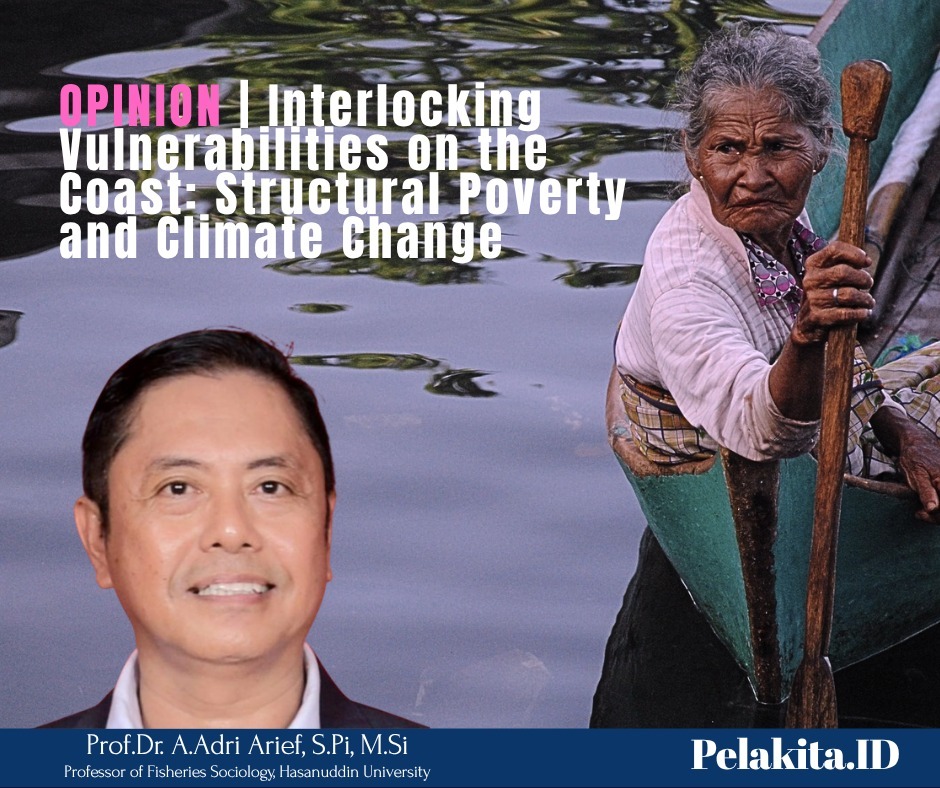
Many coastal communities are caught in a historical rupture: once rulers of the sea, now displaced and unsupported. Rather than acting as a structural balancer, the state often appears only through short-term projects: fishing gear handouts, one-off training sessions, and lifeless statistics.
maritimeposts.com/ – The climate crisis has become a deepening abyss, swallowing the certainties of life for coastal communities in Indonesia.
In places like the Spermonde Archipelago off the coast of South Sulawesi, small-scale fishers face not only the literal storms of the sea, but also the figurative storm of structural inequality: fluctuating fish stocks, shifting fishing grounds, extreme weather, and the disappearance of seasonal markers that once guided local economies.
A recent study (Idrus et al., 2024) found that 79.5% of fishing households in four Spermonde islands—Barrang Lompo, Badi, Kodingareng Lompo, and Ballang Lompo—face extreme economic vulnerability, due to a combination of coastal erosion, rising sea temperatures, and declining fish catches.
Coral bleaching has devastated marine habitats, forcing fishers to venture farther out to sea, increasing both operational costs and risks. The inability to predict rainy or dry seasons adds further uncertainty, making it nearly impossible for fishers to plan their livelihoods.
Choking Habitus: When Tradition Fails to Save
Sociologist Pierre Bourdieu described habitus as deeply ingrained social behaviors shaped by history. For coastal communities, fishing is not just economic activity—it is a lived tradition, a source of identity.
Yet in an arena disrupted by climate change and economic liberalization, this once-reliable habitus has become a burden. It fails to serve a world that now demands technological literacy, economic diversification, and access to modern markets.
Many coastal communities are caught in a historical rupture: once rulers of the sea, now displaced and unsupported. Rather than acting as a structural balancer, the state often appears only through short-term projects: fishing gear handouts, one-off training sessions, and lifeless statistics.
Shrinking Agency: A Structural Trap
According to Anthony Giddens’ structuration theory, social structures don’t only constrain—they can also enable agency. But in coastal Indonesia, fisherfolk are given little room for agency.
Top-down aid distribution, unequal access to equipment, and a lack of sustained social protection systems have severely narrowed household options.
Only 20% of fishing households have the means to diversify their income; the rest endure not from strength, but from the lack of alternatives.
National-level data reflect this pattern. A joint study by KNTI, EcoNusa, and the University of Indonesia in Aceh Selatan, Pemalang, Pangkep, and Ambon found that:
-
51% of respondents were vulnerable to climate change
-
29% faced fuel access issues
-
20% dealt with uncertainty in fishing zones
This makes the adaptive capacity theory of Smit and Wandel highly relevant: adaptation must go beyond reaction—it requires systemic transformation.
Unfortunately, adaptive strategies are often sidelined due to a lack of systemic support and meaningful policy dialogue. Fishers are left to improvise: changing fishing grounds, seeking informal jobs, or relying on family networks. Without state support, these strategies amount to exhausting survivalism, not sustainable solutions.
Coastal Women: The Forgotten Pillars
In the background, coastal women have emerged as the main agents of adaptation—even though their roles are largely invisible to the state. They manage fragile household economies, organize mutual aid groups, sew, bake, borrow from local stores, or sell household items.
From a feminist perspective, this is both double labor and invisible labor—crucial to household sustainability. Women not only manage consumption and debt, but also uphold social cohesion through shared childcare, religious groups, and informal solidarity networks.
From kitchens and front porches, coastal women resist the climate crisis in their own silent but powerful ways.
Collective Agency: Social Networks as the Last Defense
In the absence of state support, communities have built collective survival strategies: bartering, shared labor, interest-free loans, and trust-based cooperatives. These forms of social capital serve as anchors in turbulent seas.
Yet without structural backing, such autonomy becomes socially exhausting. Vertical and horizontal social networks—between fishers and patrons (punggawa, pappalele, bosses), and among neighbors—are not free from inequality. In times of scarcity, access to resources is controlled by a few.
James Scott (1990) calls this infrapolitics—subtle resistance that may, paradoxically, entrench the very systems it seeks to subvert. We must ask: why is the burden of adaptation always placed on the community, while dominant structures remain unshaken?
From Resilience to Social-Ecological Justice
Development approaches must shift from merely promoting “resilience” to embracing social-ecological justice. Climate adaptation must begin at the household level—not at the level of commodities.
Fishing households must be understood as complex socio-ecological units, not simply as passive recipients of technical interventions. Governments must help build ecosystems that support long-term income diversification—through access to capital, markets, and ongoing mentorship, not just quick-fix trainings.
Empowering women is critical. Affirmative policies such as women’s cooperatives, informal insurance schemes, and the recognition of unpaid domestic work as economic contributions are vital steps toward gender justice in climate policy.
Community-based adaptation forums should also be promoted, so local knowledge can coexist and co-evolve with scientific research—creating hybrid, context-sensitive knowledge systems.
Education must become a tool for upward mobility in coastal areas: affirmative scholarships, contextual schooling rooted in coastal ecosystems, and localized vocational training should be national priorities.
Furthermore, adaptation strategies must integrate local wisdom with science, promote sustainable fishing technologies, and establish social safety nets tailored to climate risks—so that coastal people can envision and shape their own dignified futures.
Facing Interlocking Vulnerabilities
When structural poverty and climate change intersect in coastal communities, the result is not just double suffering—but a spiraling crisis that compounds itself.
Poverty leaves households with no social or economic reserves to face unpredictable climate shocks. Meanwhile, extreme climate impacts—rising seas, erratic weather, collapsing marine ecosystems—further limit their options.
These households now face a dual threat: economic dependency on a single livelihood, and ecological vulnerability that undermines that very livelihood. Without systemic interventions, these two forces will continue to lock communities into poverty, making escape nearly impossible.
Solutions can no longer be sectoral or technocratic. We need holistic policies rooted in social-ecological justice—recognizing coastal households as agents of change with a right to a dignified life.
Revitalizing local economies, recognizing the labor of women, integrating local and scientific knowledge, and providing contextual education for the next generation are essential steps.
The state must stop demanding resilience from communities long left to fend for themselves.
What’s needed now is not mere survival—but the opportunity to thrive: socially empowered, ecologically resilient, and structurally free.
___
Editor: Denun | maritimeposts.com/