

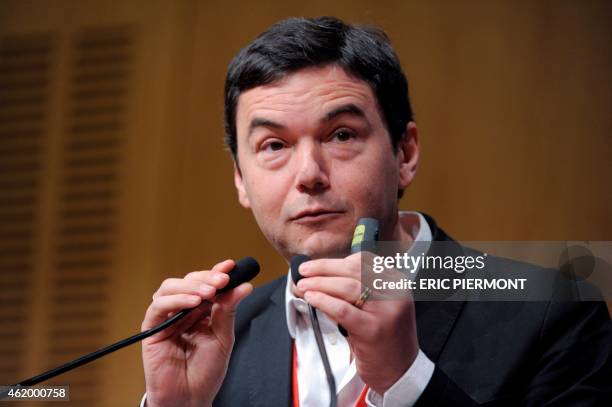
For Piketty, economic inequality is not just an economic issue but also a political one. High inequality, he warns, leads to political capture by elites, undermines democracy, and hinders inclusive development.
maritimeposts.com/ – Thomas Piketty is a French economist whose groundbreaking research has transformed the global debate on wealth and income inequality.
Born on 7 May 1971 in Clichy, France, Piketty studied at the prestigious École Normale Supérieure before earning a PhD in economics at the age of 22 from the London School of Economics and the École des Hautes Études en Sciences Sociales (EHESS).
He later became one of the founders and a professor at the Paris School of Economics.
Piketty rose to global prominence with his book Capital in the Twenty-First Century (2013), in which he examined centuries of tax and income records to trace the evolution of inequality.
His central thesis is encapsulated in the formula r > g, where r represents the rate of return on capital and g the rate of economic growth.
When the return on capital exceeds the growth of the economy, wealth naturally becomes concentrated in the hands of a few. This dynamic, he argues, was historically the norm rather than the exception, and without strong public policies—such as progressive taxation and wealth redistribution—inequality tends to worsen.
Piketty’s work has left a significant legacy in development studies.
He shifted the study of inequality from abstract models to empirical, historical analysis.
By assembling vast datasets covering centuries of economic history, he demonstrated that inequality is not merely a by-product of growth but is deeply shaped by political and institutional choices.
His research has encouraged economists and policymakers in developing countries to look beyond aggregate growth figures and focus on who benefits from economic expansion.
For Piketty, economic inequality is not just an economic issue but also a political one. High inequality, he warns, leads to political capture by elites, undermines democracy, and hinders inclusive development.
As a solution, he advocates for progressive income taxes, wealth taxes, and stronger investments in public goods such as education and healthcare.
The relevance of Piketty’s ideas to Indonesia is striking. Indonesia continues to face persistent inequality, with a Gini ratio hovering around 0.38–0.40 in recent years.
Wealth and capital ownership remain heavily concentrated among a small elite, particularly in sectors like mining, plantations, and real estate.
The logic of r > g can be seen in Indonesia: returns on capital assets frequently outpace wage growth, leaving ordinary workers behind despite steady economic growth.
Indonesia’s tax system remains relatively weak in its redistributive function. The tax-to-GDP ratio is low compared to many countries, and wealth taxes are minimal.
This means that the economic gains from growth are not effectively redistributed. Moreover, Piketty’s warnings about political capture resonate with Indonesia’s oligarchic political landscape, where wealthy elites often influence policy-making to protect their own interests.
Adopting Piketty’s insights would imply bold reforms in Indonesia. These could include broadening the tax base, implementing higher progressive taxes on income and wealth, and increasing public spending on education, healthcare, and rural infrastructure.
Such policies would not only reduce inequality but also strengthen democratic governance by limiting the disproportionate power of economic elites.
Piketty’s research reminds policymakers that economic growth alone is not enough. Without conscious political efforts to share the benefits of development, inequality will continue to deepen.
For Indonesia, engaging with Piketty’s ideas offers a chance to envision a more inclusive and democratic development path—one where prosperity is shared more fairly across society.