

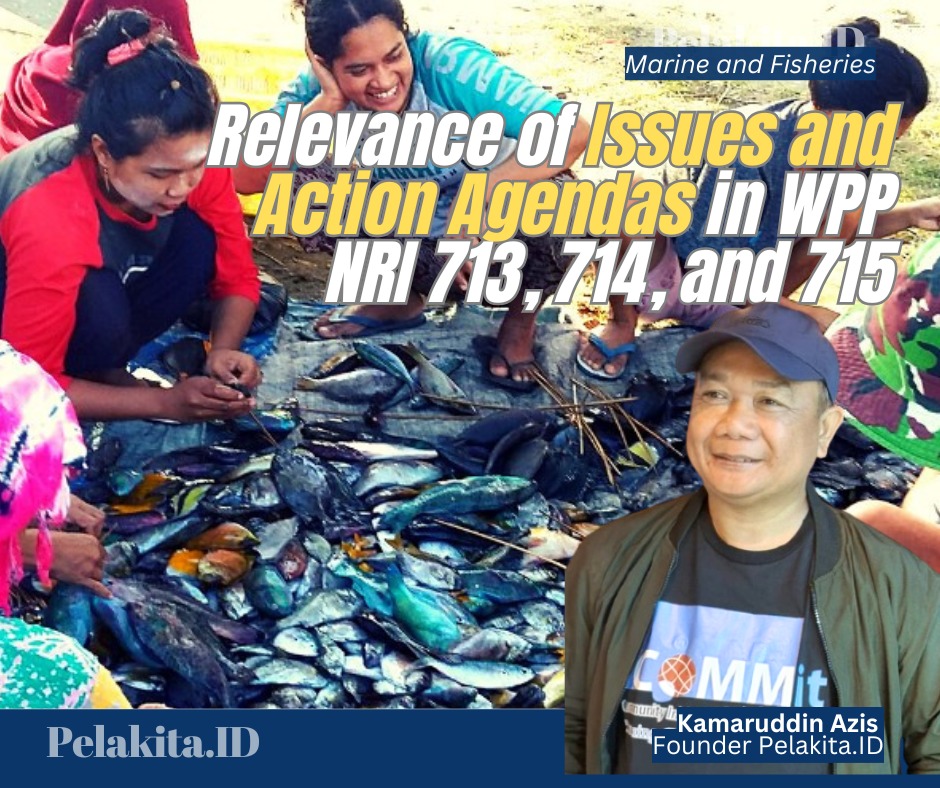
The author is the founder of maritimeposts.com/, an alumnus of Marine Science and Technology at Hasanuddin University, and former Chairman of the Hasanuddin University Marine Science Alumni Association (ISLA) for 2010–2012. He currently works as an expert for the CSR PKPM Program at PT Vale – The COMMIT Foundation.
maritimeposts.com/ – The annual meeting of the Fisheries Management Units (UPP) for Indonesia’s Fisheries Management Areas (WPPNRI) 713, 714, and 715, held from 15–19 July 2025 in Makassar, produced several significant agreements related to the sustainable management of capture fisheries.
Each management area developed an annual work plan addressing strategic issues, policy agendas, and capacity-building initiatives for fisheries stakeholders. The plans reflect the interests of various actors, including NGOs, fishing communities, universities, and authorities such as the Ministry of Marine Affairs and Fisheries.
Common Issues Across the Three WPPs
The three WPPs face similar challenges, including the implementation of the Measured Fishing Policy (Penangkapan Ikan Terukur/PIT), inter-provincial quota allocation, strengthening data-driven governance, and fostering multi-stakeholder collaboration in fisheries management.
Sustaining fishery resources, harmonizing licensing regulations, and enhancing the role of local governments in fisheries governance are also shared priorities.
Common Activities
Several activities were identified as common across the three WPPs, including:
-
Annual LPP meetings as forums for evaluation and planning.
These meetings serve as essential platforms for government agencies, academics, NGOs, and industry players to review the previous year’s fisheries management achievements and formulate the upcoming year’s work plan. They ensure coordinated, evidence-based policy-making informed by multi-stakeholder inputs. -
Evaluation and collection of PIPP data to support PIT policies.
Port Fisheries Production (PIPP) data is crucial in formulating PIT-related policies. Accurate data on catch volume, species composition, and fishing locations are essential for setting appropriate quotas and fishing zones, thereby safeguarding resource sustainability. -
Registration of small-scale fishing vessels (<5 GT) as part of improved fisheries administration.
Many small-scale fishing vessels remain unregistered, making it difficult to monitor their activities and include them in government programs. Vessel registration supports transparent governance, facilitates quota distribution, enhances enforcement, and enables fishers to access government support and empowerment programs. -
Scientific studies and stock assessments to support science-based quota determination.
Sustainable fisheries management relies on robust stock data. Scientific assessments enable the government to set catch limits aligned with ecosystem capacity, preventing overexploitation and ensuring long-term fish population sustainability. -
Enumerator training to improve the quality of catch and biological data.
Enumerators are at the frontline of field data collection. Training equips them with the skills to correctly identify species, record catch data, and measure biological parameters. High-quality data is vital for science-based decision-making in quota setting, zoning, and conservation measures.
Common Policy Directions
From a policy perspective, the three WPPs emphasized:
-
Regulatory adjustments to support PIT implementation.
Effective PIT implementation requires clear and adaptive regulations that reflect field realities. Adjustments ensure that quota rules, fishing zones, and licensing requirements can be applied effectively while safeguarding the rights of small-scale fishers. -
Strengthening equitable mechanisms for inter-provincial quota allocation.
Fair quota distribution, based on stock data, fisher capacity, and regional potential, is crucial to avoid conflicts and ensure that all provinces gain proportional access to resources. Such mechanisms also encourage shared stewardship of national fisheries resources and foster compliance. -
Simplifying licensing procedures, including for Fish Aggregating Devices (FADs) and vessel registration.
Complex licensing processes are a barrier for small-scale fishers. Streamlined procedures accelerate legal fishing activities, reduce illegal practices, and improve compliance. Registered vessels also enable better planning, monitoring, and support distribution. -
Increasing state non-tax revenue (PNBP) from capture fisheries.
Non-Tax State Revenue (PNBP) from capture fisheries is vital for funding sustainable fisheries management programs. Enhancing PNBP contributions ensures that resource utilization provides economic benefits to the state while supporting empowerment, monitoring, and conservation initiatives.
Shared Capacity-Building Initiatives
The three WPPs also prioritize capacity development through:
-
Enumerator and statistical officer training.
This ensures that fisheries data collectors possess the technical expertise to generate accurate and reliable data, which underpins stock assessments, quota allocations, and fisheries policies. -
Outreach on fisheries management strategies and new regulations.
Disseminating updated policy information helps fishers, businesses, and local governments understand their rights and responsibilities, reducing non-compliance due to lack of awareness. -
Workshops and technical training (Bimtek) on SKN and CPIB.
These programs focus on the implementation of Fishing Vessel Feasibility Certification (SKN) and Good Fish Handling Practices (CPIB), equipping fishers with the necessary skills to operate safely and handle catches properly to maintain product quality.
Differences Among the WPPs
Despite shared issues and activities, each WPP has distinct priorities:
-
WPP 713 emphasizes inter-provincial quota allocation and biological data collection for key species such as tuna, skipjack, and octopus.
-
WPP 714 focuses on policy modeling for tuna fishing vessel management and the second MSC certification for pole-and-line and handline fisheries.
-
WPP 715 highlights conservation measures, stock research in spawning areas, and engagement with international partners.
Conclusion
The three WPPs share a unified direction toward science-based, equitable, and sustainable fisheries management. However, their specific priorities reflect the unique resource potentials and challenges of each region.
Policy harmonization, regulatory alignment, and capacity-building of stakeholders are expected to be key to successfully implementing the PIT policy across Indonesia’s fisheries management areas.
The selected activities in each annual work plan underscore the urgent need to strengthen science-based fisheries governance. For example, PIPP data collection, stock assessments, and enumerator training are prioritized because accurate data serves as the foundation for fair and sustainable quota-setting.
The registration of small-scale fishing vessels (<5 GT) is also critical, given that many traditional boats remain unregistered, affecting monitoring, quota distribution, and their eligibility for government programs.
Other activities, such as PIT regulation outreach, annual LPP meetings, and policy modeling studies, are essential to ensure that all stakeholders understand the new policy directions and have platforms to provide input.
Meanwhile, MSC recertification in WPP 714 and scientific studies in WPP 715 highlight the regions’ commitment to international sustainability standards and ecosystem-based fisheries management.
Thus, each selected activity not only addresses technical field challenges but also contributes to Indonesia’s broader agenda of managing its fisheries resources transparently, inclusively, and sustainably.
___
Written by Kamaruddin Azis,
Founder of maritimeposts.com/ and Communication Specialist at ISLME – UNFAO – KKP 2020-2021