
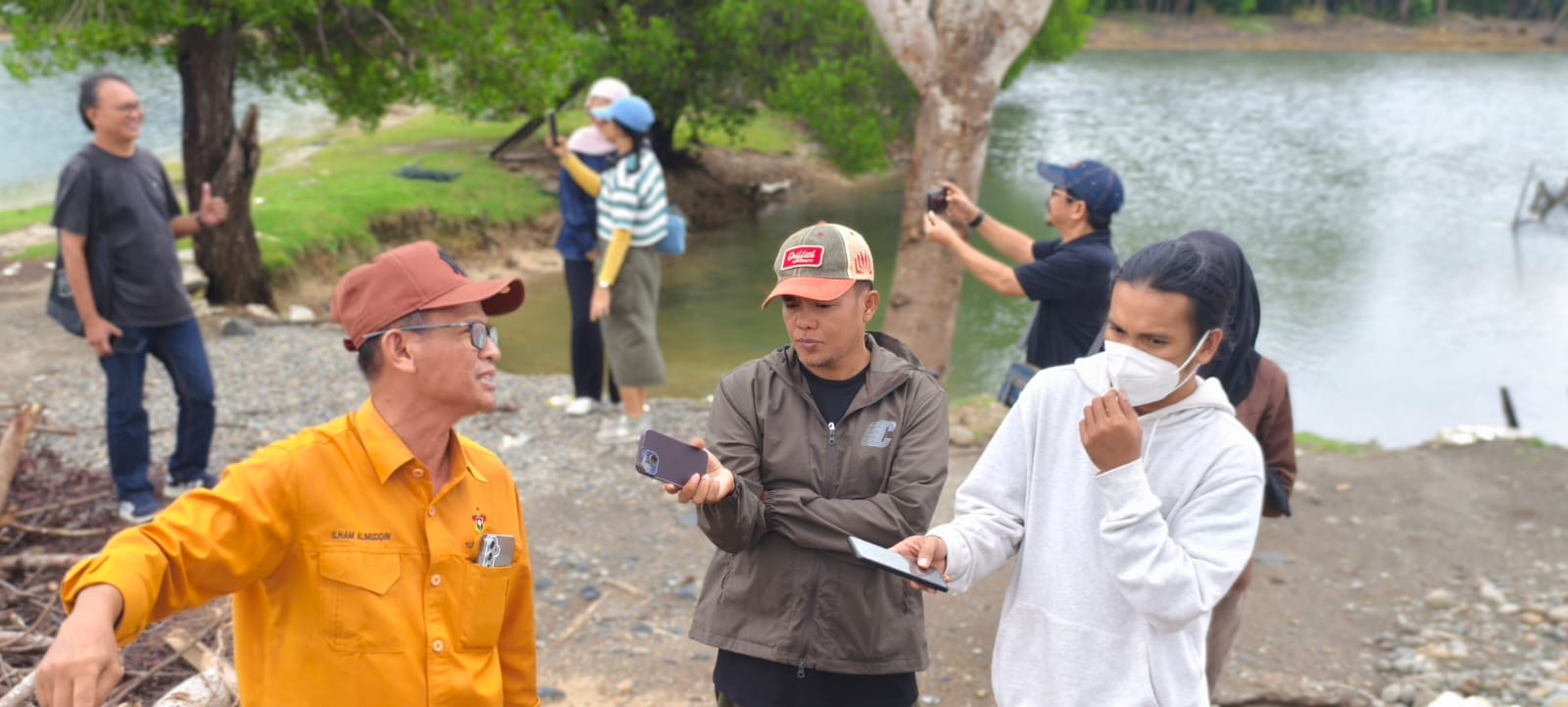
Field Visit of AIC Lab Unhas and Monash University Workshop Participants in Takalar
Daeng Tamangi, a woman approaching 60 years of age, sat on a small bench holding a thin rope while carefully tying seedlings of seaweed—clearly Eucheuma cottonii. Two other women were doing the same beside her. Several journalists stood nearby, asking questions about how ecological changes have affected their seaweed cultivation system.
maritimeposts.com/ – That scene captured the atmosphere of a field visit aimed at enriching understanding of climate change issues in Laikang Village, Takalar Regency.
The activity was part of a workshop and field visit organized by Hasanuddin University through the Australia–Indonesia Centre (AIC Lab) and Monash University on March 10–11, 2026.
The program brought together journalists, activists, and training participants who wanted to directly observe how climate change impacts are experienced by coastal communities.
According to Dr. Nana Saleh from AIC Lab Unhas, the activity served not only as a shared learning space. “This visit also provides an opportunity for participants to engage in dialogue with the village government and local residents about the changes that have occurred over the past several years,” Nana explained.
The Head of Laikang Village, Daeng Lingka, in his welcoming remarks stated that Laikang Village is located at the southeastern tip of Takalar Regency.
“This area is known as a coastal region where most residents depend on aquaculture activities such as seaweed and lobster cultivation, as well as other marine-related livelihoods,” he said.
According to him, various forms of aquaculture have developed in the village, including seaweed farming and pond-based aquaculture that have long served as the main source of income for local residents.
However, in recent years the community has begun to notice significant changes.
Daeng Lingka explained that over the past three years, aquaculture yields that were previously stable have started to decline. This situation is believed to be related to climate change, which affects water conditions, seasonal patterns, and the dynamics of the coastal environment.

“These changes are felt directly by aquaculture farmers who have long depended on relatively stable natural conditions,” he added.
During the visit, the Head of the Disaster Studies Center at Hasanuddin University, Ilham Alimuddin, also provided explanations to participating journalists about the impacts of climate change observed in the area.
He emphasized that many community members still require further education regarding climate change and its impacts on marine ecosystems.
Many residents have noticed changes in their cultivation yields or in sea conditions, but they do not yet fully understand the underlying causes.
Therefore, activities such as field visits and joint discussions are considered important for opening new spaces of understanding for both local residents and visiting participants.
After the village head’s remarks, participants visited Pontodo Hamlet. They conducted coastal observations, examined aquaculture ponds, and observed the condition of the shoreline, embankments, and seaweed seedling areas. Several journalists also conducted interviews and in-depth discussions with women working in seaweed cultivation.
Later, at Cottage Monroe, Muhammad Kasim, a resident of Puntondo, explained the socio-economic conditions of the Laikang Village community.
He noted that around one hundred households in the village depend on aquaculture pond businesses.
He also revealed that declining production in recent years has directly affected household incomes, especially for families that rely on daily earnings from aquaculture activities.
According to him, in the past farmers could obtain income almost every day. From pond or cultivation activities, they could generate regular earnings to support their families.
In some cultivation systems—such as lawi-lawi or Caulerpa spp.—harvests can begin around twenty days after planting the seedlings. This pattern allows for relatively fast economic turnover within the community.
“However, recently this condition has not always occurred. Some ponds have experienced declining productivity, and there are locations that were once fertile but are now difficult to cultivate,” he explained.
At the same time, Kasim added, there are still ponds that continue to produce well.
These differences have raised questions among local residents about environmental factors influencing aquaculture success, including the possible impacts of the power plant installation in Punaga, Jeneponto, on the coastal waters and marine environment of Laikang.
Participants also visited a waste bank facility in Puntondo Hamlet. The waste bank has emerged as a local response to the growing problem of plastic waste polluting coastal areas and the sea.
Participants in the field visit—including several journalists—responded to the presentations with a range of questions. Discussions developed around the economic impacts experienced by aquaculture households, particularly on women and children in fishing families.
When aquaculture production declines, families must find alternative ways to meet their daily needs, including education expenses and other household costs.
The dialogue highlighted how climate change affects not only the natural environment but also the social and economic structures of coastal communities.
A decline in pond production means reduced household income for families that previously depended on daily harvests.
For many households, this situation requires new adaptation strategies to survive amid increasingly uncertain environmental changes.
The field visit in Laikang Village offered a vivid picture of how climate change issues are experienced directly by coastal communities.
Through interactions among the village government, local residents, and workshop participants, the activity not only enriched understanding of local conditions but also opened space for reflection on the importance of adaptation, education, and collaboration in addressing climate change challenges in coastal areas.
Editorial Team