
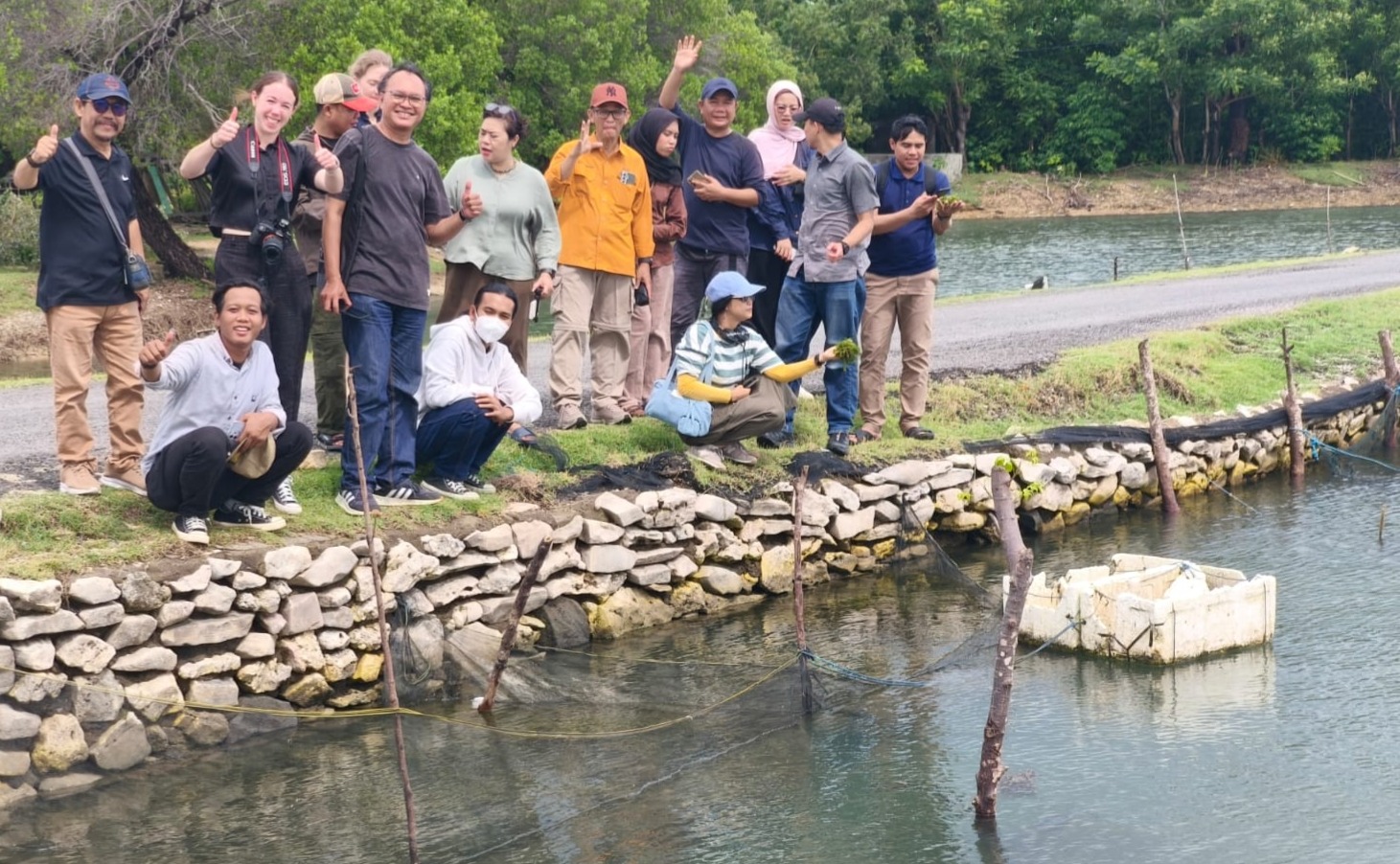
The future demands a proactive approach built around resilience: anticipating risks, strengthening ecosystems, and preparing communities for an increasingly unstable climate.
maritimeposts.com/ – It is March 2026, and the comforting illusion that climate change is a problem for the distant future has finally collapsed. For more than three decades scientists issued warnings. For the last ten years, Indonesians have begun living the consequences.
During a climate reporting workshop at the AIC Lab of Hasanuddin University in Makassar, Rector Jamaluddin Jompa delivered remarks that sounded less like a ceremonial welcome and more like a call to confront a new reality.
His message was blunt: why are we still talking about “prevention” when the house is already on fire?
Indonesia, like much of the world, is no longer standing at the edge of a climate crisis.
It is already navigating its depths. The question is no longer “What if climate change happens?” but “What do we do now that it is here?”
From that discussion emerged five uncomfortable truths about Indonesia’s climate reality—truths that demand a shift in how we think, speak, and act.
1. The Ten-Year Reality Check
The argument that today’s environmental changes are merely part of a “natural cycle” is increasingly difficult to defend. Long-term data has shown that the environmental baseline itself has shifted.
Mass coral bleaching events recorded since the late 1990s offer clear evidence. These events were once dismissed as temporary anomalies, yet many reefs failed to recover. Their decline corresponded with rising sea temperatures that continued to climb year after year.
Human psychology often struggles to recognize slow-moving disasters. People react quickly to sudden floods or earthquakes, but gradual environmental changes can remain invisible until their effects accumulate.
In Indonesia’s seas, forests, and coastlines, those accumulated effects are now undeniable.
2. From Prevention to Survival and Adaptation
Perhaps the most important shift in climate discourse today is linguistic. For years, governments and institutions spoke primarily about prevention—reducing emissions, slowing warming, and avoiding future impacts.
But in 2026, that narrative alone is no longer sufficient.
“For colleagues in the media, the narrative of climate change can no longer focus merely on prevention in the future. We are now already in a phase of survival and adaptation,” Prof. Jompa.
For many Indonesian communities—especially those living along the coast—the impacts are already visible. Shorelines are shifting, fish stocks are changing, rainfall patterns have become less predictable, and farming seasons are increasingly uncertain.
In other words, climate change is no longer something to prevent. It is something people must learn to survive.
This shift from “prevention” to “adaptation” is not a surrender. It is a strategic acknowledgment that the emergency is already unfolding.
3. Indonesia’s Coastlines Are a National Defense System
As the world’s largest archipelagic country, Indonesia’s natural ecosystems serve functions far beyond biodiversity.
Coral reefs, seagrass beds, and mangrove forests form a natural barrier that protects coastlines from erosion, storms, and rising seas. They are not simply environmental assets—they are part of the country’s security infrastructure.
These ecosystems also play a central role in storing “blue carbon,” making them critical in global climate mitigation efforts.
When coral reefs die or mangroves are cleared, the loss is not merely ecological. It weakens coastal resilience, threatens fisheries, and exposes communities to greater risks from storms and flooding.
Protecting these ecosystems therefore becomes not only an environmental priority but a matter of national security and public welfare.
4. Media Determines What Governments Prioritize
One of the strongest messages delivered during the workshop concerned the role of journalism.
Public attention influences political action. Issues that dominate headlines often dominate policy agendas as well.
When climate change receives only occasional coverage, it struggles to compete with daily political drama or short-term economic debates.
Yet consistent reporting can reshape public awareness and, eventually, public policy.
Media organizations therefore hold a powerful responsibility. By continuously highlighting climate impacts and solutions, they help ensure that adaptation and environmental resilience remain at the center of national conversation.
Without sustained coverage, even the most urgent environmental crises risk being treated as secondary concerns.
5. Science Must Leave the Laboratory
Another major theme raised during the discussion was the need to move scientific knowledge beyond academic journals.
For decades, universities measured success largely through research publications. While those remain important, climate challenges demand something more: practical solutions that directly benefit communities.
In Indonesia, this shift is often described as hilirisasi riset—the downstreaming of research into real-world applications.
Examples are already emerging. At Hasanuddin University, researchers are working on climate-adaptive agriculture and sustainable coastal management. Meanwhile, new circular economy initiatives are exploring ways to convert organic waste into productive resources.
One recent project supported by the United Kingdom focuses on organic waste processing as part of a broader “zero-waste” strategy. The initiative aims not only to reduce environmental pollution but also to strengthen feed systems and food security.
In this model, science becomes a tool not just for academic knowledge but for everyday resilience.
Toward a Proactive Future
Indonesia can no longer rely on reactive governance—responding to disasters only after they occur.
The future demands a proactive approach built around resilience: anticipating risks, strengthening ecosystems, and preparing communities for an increasingly unstable climate.
Such a transformation requires collaboration across sectors—government, universities, civil society, the private sector, and the media.
It also requires a cultural shift in how people interact with the environment, from managing waste responsibly to protecting coastal ecosystems.
In many ways, the challenge reflects a deeper ethical principle often invoked in Indonesian society: the responsibility to act as rahmatan lil ‘alamin, a blessing and guardian for the world.
The climate crisis has removed the luxury of delay. The question now is not whether change is necessary, but whether society is ready to embrace it.
The future of Indonesia’s environment—and the resilience of the communities who depend on it—will depend on the answer.
___
Author: Kamaruddin Azis