

maritimeposts.com/ – Throughout history, certain individuals have stood out as catalysts for social transformation, embodying the courage, conviction, and vision needed to confront injustice.
From India to the United States, South Africa to Sweden, their efforts shaped not only their societies but also global movements for freedom, equality, and justice. The following figures represent some of the most influential actors in social movements worldwide.
Mahatma Gandhi (India)
Mahatma Gandhi is best known as the leader of India’s nonviolent independence movement against British colonial rule. His philosophy of satyagraha (truth-force) emphasized civil disobedience, peaceful protest, and moral resistance as powerful tools against oppression.
Gandhi mobilized millions of Indians through iconic actions such as the Salt March in 1930, which protested the British salt tax, and campaigns calling for swaraj (self-rule). His disciplined approach to nonviolence inspired not just Indians but global activists confronting injustice.
Beyond India’s freedom struggle, Gandhi’s ideas became a moral blueprint for movements across the world. His teachings influenced Martin Luther King Jr. in the United States, Nelson Mandela in South Africa, and countless peace and justice campaigns in Asia, Africa, and Latin America. ‘
Gandhi’s legacy is remembered not only for political liberation but also for his emphasis on ethical living, simplicity, and social reform—such as efforts to end caste discrimination and promote communal harmony.
Martin Luther King Jr. (United States)
Martin Luther King Jr. was the face of the American Civil Rights Movement during the 1950s and 1960s. Drawing heavily on Gandhi’s philosophy, he championed nonviolent resistance against racial segregation, systemic discrimination, and voter suppression in the United States.
King rose to prominence during the Montgomery Bus Boycott in 1955 and went on to organize pivotal events like the 1963 March on Washington, where he delivered his legendary “I Have a Dream” speech.
His activism pressured lawmakers to pass transformative legislation, including the Civil Rights Act of 1964 and the Voting Rights Act of 1965.
King’s influence extended beyond civil rights into economic justice and opposition to the Vietnam War. He launched the Poor People’s Campaign shortly before his assassination in 1968, aiming to unite working-class Americans across racial lines to demand fair wages, housing, and healthcare. His life and tragic death cemented him as a martyr for justice, and his words continue to resonate globally as a symbol of the struggle for equality, dignity, and peace.
Nelson Mandela (South Africa)
Nelson Mandela became a global icon of resistance to apartheid, South Africa’s brutal system of racial segregation. Initially committed to peaceful protest, Mandela co-founded the armed wing of the African National Congress (ANC) in 1961 after decades of repression and violence against Black South Africans. Arrested in 1962 and later sentenced to life imprisonment,
Mandela spent 27 years behind bars, becoming the most famous political prisoner in the world. His imprisonment galvanized international solidarity movements that demanded an end to apartheid.
Upon his release in 1990, Mandela led negotiations that dismantled apartheid and ushered in a democratic South Africa. In 1994, he became the country’s first Black president, symbolizing both reconciliation and victory over institutionalized racism.
Mandela’s presidency emphasized nation-building, forgiveness, and unity, even as deep social inequalities persisted. His life story embodies resilience and the power of collective struggle against injustice, making him one of the most admired figures in modern history.
Gloria Steinem (United States)
Gloria Steinem is a leading feminist activist, journalist, and political organizer who emerged as a central figure in the women’s liberation movement in the 1960s and 1970s. She co-founded Ms. Magazine, which gave voice to feminist issues such as reproductive rights, workplace equality, and the fight against gender-based violence.
Steinem’s advocacy combined sharp intellectual critique with grassroots activism, helping to challenge cultural norms that limited women’s roles in society.
Her activism extended beyond gender equality; she was also engaged in broader struggles for social justice, including civil rights, LGBTQ+ rights, and peace activism. Steinem’s ability to connect feminism to intersecting issues of race, class, and global inequality made her a transformative figure in global activism. Even today, she continues to inspire new generations of feminists with her insistence that change requires both systemic reform and cultural transformation.
Greta Thunberg (Sweden)
Greta Thunberg, a Swedish climate activist, gained international recognition at just 15 years old when she began skipping school to protest outside the Swedish Parliament, demanding stronger action against climate change. Her solitary protest sparked a global movement known as Fridays for Future, which mobilized millions of young people worldwide to demand accountability from governments and corporations.
Thunberg’s straightforward, uncompromising speeches—such as her 2019 address at the United Nations, where she told world leaders, “How dare you!”—captured global attention.
Beyond her symbolic leadership, Thunberg has been instrumental in reframing climate change as a moral and generational issue, emphasizing scientific consensus and intergenerational justice.
She rejects personal glorification, often reminding audiences to focus on collective action rather than individual heroes. Despite criticism from political figures and climate skeptics, her activism has succeeded in amplifying youth voices and keeping climate justice high on the global agenda.
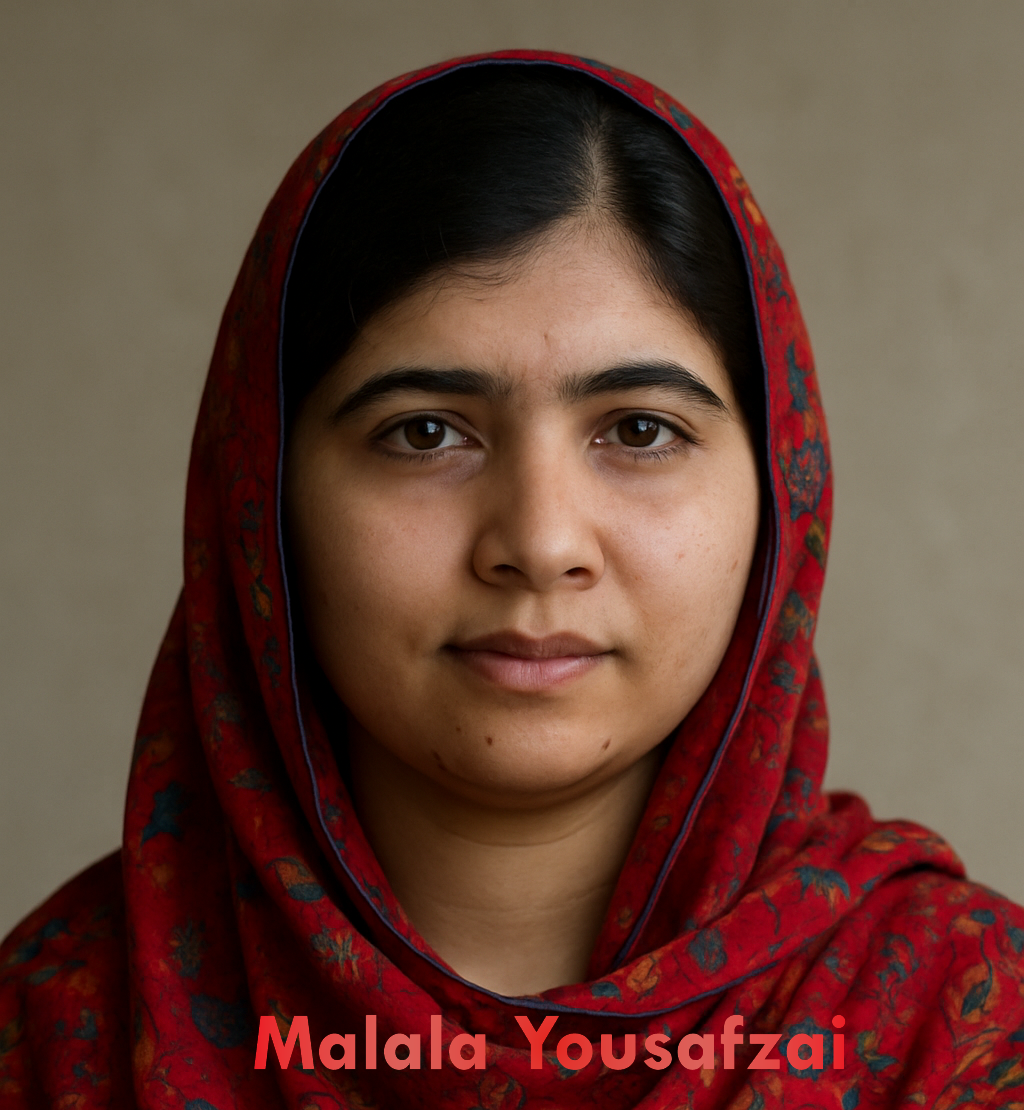
Malala Yousafzai (Pakistan)
Malala Yousafzai rose to international prominence as a teenager after surviving a Taliban assassination attempt in 2012. Targeted for her outspoken defense of girls’ right to education in Pakistan’s Swat Valley,
Malala turned tragedy into global activism. She co-founded the Malala Fund, an organization dedicated to ensuring that girls worldwide can access 12 years of free, safe, and quality education. Her advocacy quickly gained international recognition, culminating in her receiving the Nobel Peace Prize in 2014 at just 17 years old, making her the youngest laureate in history.
Malala’s story transcends her personal experience; she has become a symbol of resilience against extremism and a voice for the 130 million girls worldwide denied education. Speaking at the United Nations, she urged global leaders to prioritize education as a pathway to peace and prosperity.
Despite criticism from some in Pakistan who see her as a Western symbol, Malala remains deeply committed to her roots while amplifying local voices in a global fight for education. Her courage continues to inspire young activists everywhere.
Rosa Parks (United States)
Rosa Parks (1913–2005) is often called “the mother of the civil rights movement” for her quiet act of defiance on December 1, 1955, in Montgomery, Alabama, when she refused to give up her bus seat to a white passenger. This simple but courageous act sparked the Montgomery Bus Boycott, a year-long protest led by Martin Luther King Jr. that eventually led to the desegregation of public buses. Parks’ resistance highlighted how ordinary individuals could ignite extraordinary change.
Her activism didn’t end with that moment. Parks continued to work for civil rights causes throughout her life, advocating for justice, equality, and the empowerment of African Americans.
She became a symbol of dignity, strength, and courage, reminding future generations that systemic injustice can be challenged through steadfast resistance, even by individuals who appear powerless.
Conclusion
These figures represent diverse movements—independence struggles, civil rights, feminism, climate justice, and the right to education—yet they share a common thread: the ability of individuals to spark profound social transformation. Their lives demonstrate that courage, vision, and collective action can overcome oppression and inspire a fairer, more just world.