

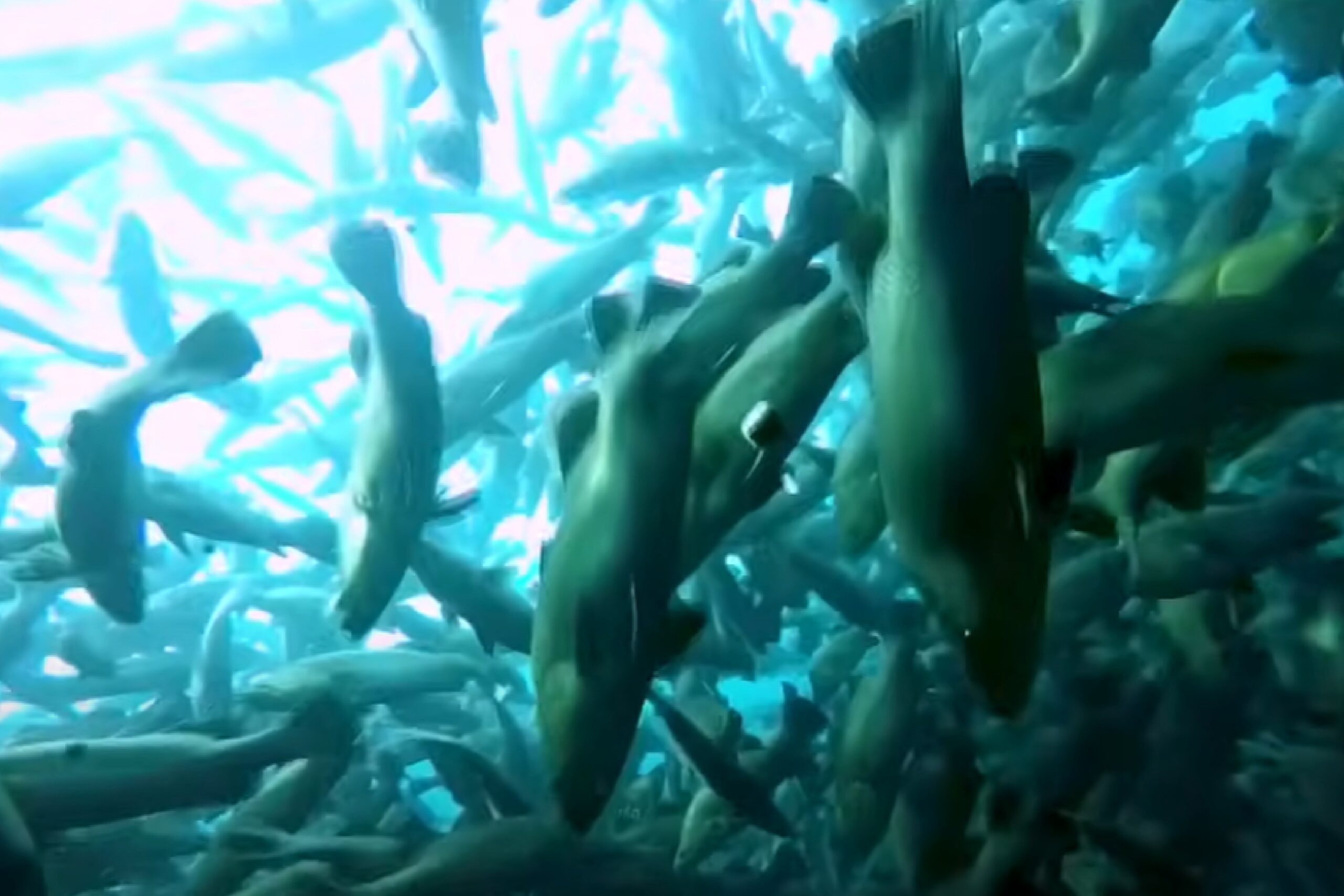
maritimeposts.com/ – Did you know that aquaculture is the fastest-growing food production sector in the world? This is because seafood is one of the rare types of food that is highly beneficial to humans while also being easily scalable in production.
With the help of innovative technologies such as artificial intelligence and microscopic fungi, almost every country with access to the sea will be able to completely solve the issue of its own seafood shortage. Today, we will look at exactly how advanced technologies will help feed the entire planet.
People have been going to the sea for food since ancient times. In the last century, fishing has become so widespread that hundreds of marine life species have become endangered.
According to the International Union for the Conservation of Nature, more than 90 species of fish, including sharks, rays, and other cartilaginous fish, are at risk in European waters alone. Nicolas Dolvey, a marine ecologist at Simon Fraser University in Burnaby, Canada, points out that there has been no effective movement on fisheries management in the Mediterranean in the last decade.
To make matters worse, different countries have various fishing laws, and what is prohibited in one country may easily be allowed in another. This results in fishing boats being able to catch even illegal fish species and sell them in other markets.
The same is true in other parts of the world. For instance, Blue Ocean activist Michael Awe documented the case when ten fishing boats caught 100 to 150 tons of sardines per day to ship them to Europe. Such a massive catch endangers not only sardines but also dolphins, gulls, and penguins, which rely on sardines as their main food source.
In response to these concerns, aquaculture—breeding and cultivating marine organisms for food—has begun to actively develop around the world. This helped slow down the disappearance of species, though it could not stop it entirely. Now, with new technologies, the disappearance of rare marine life could potentially be stopped altogether.
Sea farms allow the growth of almost all types of seafood, but most require fish, shellfish, or other organisms as feed. For example, the sardines mentioned earlier are intensively imported by Norwegian companies to grow salmon.
This creates a vicious circle where aquaculture saves some fish species from extinction but simultaneously consumes others.
A way out of this situation was proposed by the Siwa Tech AB technology company, which developed a process for growing microscopic fungi on industrial waste. This innovation solves two problems at once: disposing of waste and producing high-quality fish feed.
The technology is currently undergoing pilot testing at a sulfate plant under the supervision of Nordic Paper. After the pilot project, it could be scaled to the entire European Union and eventually to the world. With this, one of the main problems of aquaculture—dependence on marine life for feed—could be solved in the coming years.
Meanwhile, Apollo Aquaculture Group in Singapore has found a solution to another major problem: cost reduction. While fish farms require relatively modest capital expenditures for construction, equipment, and initial stock, their operating costs are very high. These include feed, constant water purification, fish treatment, and maintenance of technical systems.
To address this, Apollo built the world’s first vertical eight-story fish farm. Vertical construction was necessary due to land scarcity in Singapore, and the farm’s planned capacity is 3,000 tons of sea bass, coral trout, and shrimp annually—six times more efficient than conventional fish farms in the country.
To increase efficiency, Apollo introduced several innovations. One is the Aqua Deck system, an automatic water renewal system. Once water becomes contaminated, it is pumped out, purified through special filters, and returned to the farm.
This significantly reduces the costs of water replacement and labor. Another is the electronic inventory system, which allows real-time monitoring and data sharing among purchasing, technical, and sales departments. The system measures water condition and feed amounts down to a single gram per cubic meter of water, enabling faster fish growth to the right market size.
However, perhaps the most revolutionary development in aquaculture comes from Biosort’s iFarm project. This startup uses artificial intelligence and machine learning to monitor each individual fish on the farm.
Every time a fish rises to the surface for air, it passes through a sensor that records its weight, growth rate, and health indicators such as parasites or sores.
All the data is stored in an individual medical catalog. According to Carl Frederick Autumn Cermax, the iFarm project manager, the goal is to improve fish health and welfare while strengthening the competitiveness of coastal farming.
The prospects of this technology are significant. Real-time monitoring will reduce maintenance costs, improve fish health, and help determine the optimal time for harvest based on each fish’s development. In the long run, iFarm aims to create systems that allow individual fish to be treated or harvested one by one.
Testing began in 2021 with 150,000 salmon, and the trials will continue until 2025. During this time, the company plans to refine its algorithms and expand globally.
So far, we have seen three groundbreaking innovations. The first addresses fish feed sustainability, the second reduces operational costs, and the third improves overall production efficiency.
If all three become global, they could spark a revolution in aquaculture, fundamentally transforming seafood farming and helping to solve the ecological problem of fish extinction.
The big question that remains is whether humanity will be able to implement these advanced developments on every fish farm around the world. What do you think?
Source: